OPP Meaning Slang
If you keep seeing Opp or opps in texts, TikTok captions, Snapchat chats, gaming lobbies, or rap lyrics, the meaning is usually simple: it refers to an opponent, opposition, rival, or enemy. Merriam-Webster defines opps as “opposition or opponents,” and it notes that the singular opp also exists, though the plural form is more common. Later gives a similar social-media definition, explaining that it refers to someone seen as an adversary or someone involved in a conflict or disagreement.
That is the core meaning, but context matters a lot. In rap and drill culture, the word can sound serious because it is tied to conflict, loyalty, and rivalry. Online, especially on TikTok and in memes, it is often used more playfully or exaggeratedly to mean a hater, fake friend, ex, or anyone acting against you. Know Your Meme traces the term to African-American Vernacular English and hip-hop culture, while noting that it spread widely online in the late 2010s and was further popularized by Chicago rappers, including Chief Keef.
Quick Meaning Summary
| Term | Simple meaning | Tone | Common use |
| opp | one opponent or rival | serious or playful | text, rap, gaming |
| opps | more than one opponent | serious or playful | rap, TikTok, memes |
| opposition | the other side | formal | dictionary-style meaning |
| enemy/rival | someone against you | direct | casual slang |
What Does OPP Mean?
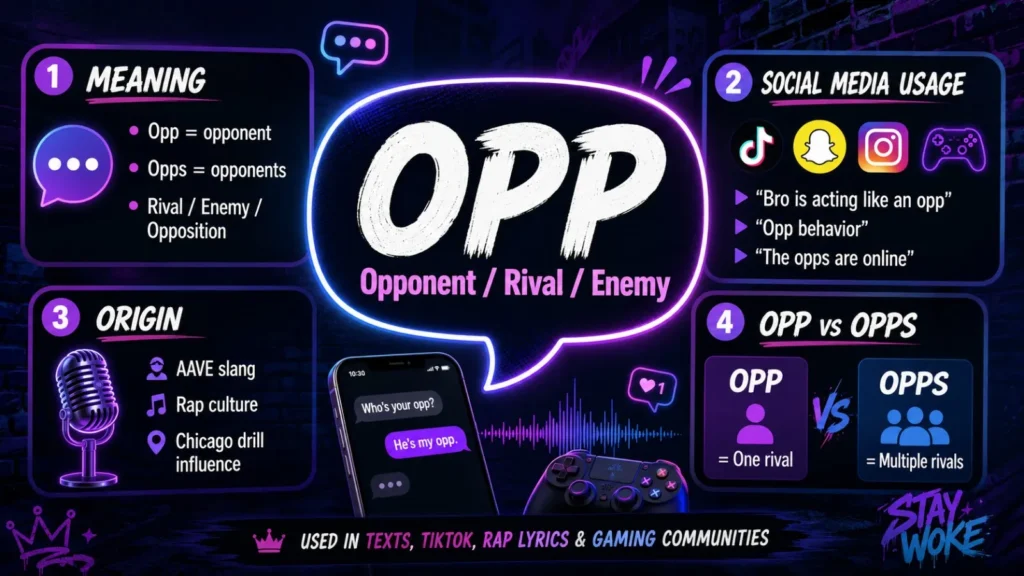
The simplest answer is this: opp means opponent or opposition. In slang, it points to a person or group that is on the opposite side of a conflict, competition, or social situation. Babbel defines the modern slang sense as “opposition/enemies,” FamilyEducation describes it as short for “opposition” or “opponent,” and Later says it is used for someone viewed as an adversary.
In everyday English, you can think of it like this:
- opp = one rival, one enemy, or one person against you
- opps = several rivals, enemies, or people against you
OPP vs. Opps: What Is the Difference?
This is one of the most searched follow-up questions, and the answer is easy.
opp is usually singular.
opps is plural.
Merriam-Webster specifically says the word can be used in the singular, but it appears more often in the plural form.
Comparison Table
| Form | Number | Example |
| opp | singular | “He is my opp.” |
| opps | plural | “Watch out for the opps.” |

Where Did OPP Come From?
The slang meaning grew out of hip-hop and AAVE usage, then became strongly associated with Chicago drill and online youth culture. Know Your Meme describes opp / opps as an African-American Vernacular English slang term popularized in hip-hop and rap, and it says the term spread online in the late 2010s. Daily Dot also links the term to opposition/opponents and notes its modern popularity in online slang.
Babbel adds that the term can also connect to other meanings in other contexts, including “opportunity” and a reference made famous by the 1991 Naughty by Nature song “O.P.P.” But for today’s slang search intent, the meaning most users want is still opponent/enemy/rival.
Why Is OPP So Popular Online?
OPP stays popular because it is short, sharp, and expressive. It works in jokes, captions, arguments, gaming chat, and rap lyrics. On social media, it can sound dramatic in a funny way, which makes it ideal for memes and reaction posts. Later’s glossary entry and Know Your Meme’s meme documentation both show how the term moved from Cultural Slang into broader internet use.
How Is OPP Used in Text, TikTok, Snapchat, Gaming, and Rap?
1) In Text Messages
In texting, opp usually means someone being shady, unsupportive, rude, or competitive.
Examples:
- “Bro is acting like an opp.”
- “My ex is my biggest opp.”
- “Stop moving like an opp.”
2) On TikTok
On TikTok, the word is often used in skits, captions, comments, and trend language. It may be a joke, but the meaning still points to an enemy, rival, or fake friend. Know Your Meme shows the word being used in meme templates and TikTok-style humor, especially in catchphrase formats such as calling someone an “opp” for doing something wrong or embarrassing.
3) On Snapchat
On Snapchat, opp is usually more private and emotional. People may use it for an ex, someone they do not trust, or a person they are upset with.
Examples:
- “She’s not my friend anymore. Real opp behavior.”
- “I blocked the opps.”
4) In Gaming Chat
In gaming, the meaning is similar to enemy team or opponent. It can be used casually in competitive games:
- “The opps are pushing mid.”
- “We beat the opps in the final round.”
5) In Rap and Drill Culture
This is where the term has the strongest cultural weight. Merriam-Webster and Know Your Meme both connect the slang to opposition and rap culture, and Know Your Meme highlights Chicago drill and Chief Keef as important in the term’s spread. In rap, the word can signal real tension, territorial conflict, or loyalty to one’s own group.
Real Examples of OPP in Sentences
- “He is my opp because he always tries to compete with me.”
- “The opps are outside.”
- “Stop acting like an opp over one comment.”
- “She called me an opp as a joke.”
- “On TikTok, opp often means a fake friend or rival.”
Is OPP Always a Bad Word?
Not always. The tone depends on the setting.
In serious contexts, opp can sound threatening or hostile. In casual online use, it can be Playful, sarcastic, or exaggerated. That is why the same word can mean genuine conflict in rap culture and light teasing in a TikTok comment.
Common Misunderstandings
1) Opp is not the same as OP.
In Gen Alpha slang, OP can mean “overpowered” in gaming, while opp means opponent or enemy. FamilyEducation lists both terms separately, which is a useful reminder that they are not interchangeable.
2) Opp is not always literal violence.
Online, people often use it loosely for a hater, rival, ex, or annoying person. The word can be serious, but social media frequently turns it into a joke.
3) Opps is more common than opp.
Merriam-Webster notes that the plural form appears more often in usage.
Related Terms and Similar Meanings
These words often appear near opp in search and social usage:
- opponent
- opposition
- enemy
- rival
- adversary
- hater
- fake friend
- beef
- enemy team
- conflict
People Also Ask
A: It usually means opponent, enemy, rival, or someone against you. The meaning changes a little based on whether it is used in text, rap, gaming, or social media.
A: Not exactly. Opp is singular, while opps is plural. Merriam-Webster says the singular form exists, but the plural is more common.
A: The slang is linked to AAVE, hip-hop, and rap culture, with strong associations to Chicago drill and later online meme culture.
A: On TikTok, it often means a rival, hater, fake friend, or someone who is against you. In many cases, it is used jokingly rather than literally.
A: It can be, depending on context. In a joke, it may be harmless, but in a serious rap or street context, it can imply real hostility or conflict.
Conclusion
The OPP meaning in slang is simple but depends heavily on context. In most modern conversations, opp means an opponent, rival, enemy, or someone who is against you. The plural form opps refers to multiple opponents or rivals.
The term has strong roots in hip-hop, rap, and drill culture, where it can describe serious opposition or conflict. However, on platforms like TikTok, Snapchat, Instagram, gaming chats, and text messages, it is often used in a lighter way to describe a hater, fake friend, ex, competitor, or someone acting against you.
Understanding opp vs opps is also important: opp refers to one person, while opps refers to more than one. As internet slang continues to evolve, the word has moved beyond its original communities and become a common part of Gen Z and online vocabulary.
Whether you see it in a meme, a comment section, a rap lyric, or a private message, the best way to understand opp is to look at the situation around it. Context determines whether it means a serious rival or just a playful joke.
If you enjoy learning modern internet slang, explore More Guides on Trending TikTok words, texting abbreviations, and Gen Z expressions to stay updated with today’s digital language.