TW Meaning in Text
If you have seen TW in a text message, caption, comment, or social media post, it most often means Trigger Warning. In simple terms, it is a heads-up placed before sensitive material so the reader or viewer knows what is coming next. Cambridge defines a trigger warning as a statement placed at the beginning of a piece of writing or film to warn the audience that the content may be upsetting, while its definition of content warning is similar but broader.
That is why TW Meaning in Text is such a common search. People want the fastest possible answer, but they also want to know when TW should be used, how it differs from CW, and what to say back when someone sends it. In everyday texting and social media, TW is usually the most direct way to label sensitive content.
Quick Meaning Summary
| Term | Full meaning | Best use | Example |
| TW | Trigger Warning | Before sensitive or emotionally heavy content | TW: grief mention below |
| CW | Content Warning | Before broader upsetting or offensive material | CW: violence in this post |
| Other TW meanings | Taiwan, terawatt, and other abbreviations | Only when context clearly points elsewhere | TW can mean Taiwan in dictionary references; TW can also mean terawatt in Oxford’s abbreviation entry. |
What Does TW Mean in Text?
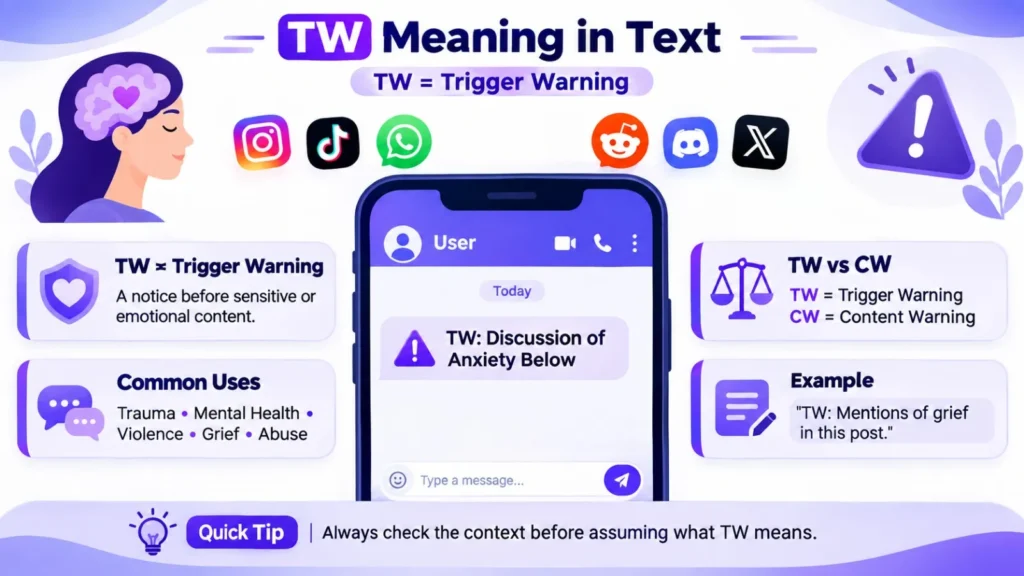
TW stands for Trigger Warning. It is a short notice that tells readers a message, post, or video may contain material that feels disturbing, emotional, or difficult to process. Dictionary sources and university guidance describe trigger warnings and content warnings as notices placed before potentially upsetting content, including material about trauma, self-harm, violence, grief, or abuse.
In plain English, TW means: “Pause for a moment before reading this.” It is not meant to censor the content. It is meant to give people a choice about whether they want to continue. That is why it is widely used in online communities, captions, and chat messages.
Why People Use TW
People use TW because written content can land differently for different readers. A topic that feels ordinary to one person may feel overwhelming or triggering to another. Cambridge University’s guidance on content notes explains that these warnings can help people prepare emotionally or decide not to engage with the content, and Waterloo similarly describes them as notices before potentially disturbing material.
That makes TW a form of digital courtesy. It signals care, not weakness. It also helps the writer communicate responsibly when the topic involves trauma, loss, mental health, or graphic detail.
TW vs. CW: What Is the Difference?
TW usually means Trigger Warning, while CW usually means Content Warning. Cambridge defines both terms as warnings before material that may upset or offend readers, but content warning is broader, while trigger warning is more closely tied to emotionally triggering or trauma-related content. That is the practical difference most readers care about.
A simple way to remember it is this: TW is more Specific, and CW is more general. In real-world posting, many people use them almost interchangeably, but if you want to be precise, use TW for trauma-sensitive content and CW for broader sensitive topics. That interpretation follows the way major dictionary sources separate the two definitions.
Where You May See TW
You may see TW in captions, comments, group chats, discussion threads, and short-form social posts. Current explainers place it in places like Instagram, TikTok, Facebook, Reddit, Discord, and general chat spaces, especially when the author is about to discuss something emotionally heavy.
Typical formats look like this:
- TW: grief discussion
- TW // violence mention
- TW: anxiety and panic attacks
- TW: abuse story below
These formats are short, clear, and easy to scan, which is why they work so well in fast-moving online spaces.
Real Examples of TW in Text
Here are a few simple examples:
- TW: I am talking about a hard breakup today.
- TW: Mentions of blood in the next slide.
- TW: This post discusses anxiety and burnout.
- TW: Grief story from last year.
In each case, TW is doing the same job: it warns the reader before the main content starts. That makes the message more considerate and easier to handle.
Other Meanings of TW
Although Trigger Warning is the main meaning in text and social media, TW can mean other things in other contexts. Dictionary.com and Collins list TW as Taiwan in one context, and Oxford Learner’s Dictionaries lists TW as terawatt in its abbreviation entry. That is why the surrounding words matter so much.
If the message is about a serious personal topic, TW almost certainly means Trigger Warning. If the text is about geography, science, engineering, or an abbreviation list, the meaning may be different. Context is the safest guide.
How to Know What TW Means in a Message
Look at the words around it. If the message is about mental health, violence, grief, trauma, or abuse, TW usually means Trigger Warning. If the message is about Taiwan, energy, or a technical abbreviation, TW may mean something else. That context-based reading is supported by the way major dictionaries separate the abbreviation’s meanings.
A fast test is this: if TW appears before a personal or emotional post, read it as a warning. If it appears in a glossary, news reference, or technical note, check the full context before assuming the meaning.
How to Reply When Someone Sends TW
A reply to TW does not need to be long. A calm and respectful response is usually the best choice.
Good replies include:
- “Got it, thanks for the warning.”
- “Okay, I will read it later.”
- “Thanks for the heads-up.”
- “Understood, take your time.”
If the topic is serious, a thoughtful response works better than a joke. The point of TW is to make the conversation safer and more considerate.
Common Mistakes People Make
One common mistake is assuming TW always means the same thing everywhere. It does not. Another mistake is treating TW as rude or dramatic when it is usually just a courtesy warning. A third mistake is skipping context and guessing Too Fast. Dictionary sources show that TW has more than one meaning, so the words around it matter.
Related Terms and Similar Meanings
Here are the closest related terms:
- CW = Content Warning
- NSFW = Not Safe for Work
- Spoiler warning = a warning about plot details
- Reader discretion advised = a broader formal warning
These are not identical, but they all help the audience prepare for what is coming next.
People Also Ask
A: TW usually means Trigger Warning. It is a short label placed before sensitive content so the reader can decide whether to continue. In most chats and social media posts, that is the meaning people intend.
A: Not exactly. TW is usually more trauma-focused, while CW is broader and can cover upsetting or offensive content in general. Many people use them loosely, but the distinction is still useful.
A: No. In dictionaries, TW can also mean Taiwan or terawatt, depending on context. In everyday texting and social media, though, Trigger Warning is the most common meaning.
A: It is common in captions, comments, group chats, and posts on platforms like TikTok, Instagram, Reddit, Discord, and Facebook. It shows up right before sensitive or emotional content.
A: A simple, respectful reply is best. Say things like “Thanks for the warning” or “I will read this later.” You do not need to overthink it.
Conclusion
Understanding the TW meaning in text is easy once you know the context. In most text messages, social media posts, and online conversations, TW stands for Trigger Warning—a short notice that lets readers know the following content may be sensitive, emotional, or disturbing. It is a simple way to communicate with empathy and give others the choice to continue reading or skip the content.
While TW can have other meanings in specific fields, Trigger Warning is by far the most common interpretation on platforms like Instagram, TikTok, Reddit, Discord, WhatsApp, and X. If you’re ever unsure, look at the surrounding conversation before deciding what the abbreviation means.
Now that you know what TW means, when to use it, and how it differs from CW (Content Warning), you’ll be able to understand online conversations more confidently and Communicate more Thoughtfully. If you’re interested in learning more internet slang and texting abbreviations, explore our related guides to stay up to date with the latest digital language.