Trifling Slang
The word trifling has two lives in English. In formal dictionary usage, it usually means something small, unimportant, or trivial. Merriam-Webster defines it as “lacking in significance or solid worth,” and Cambridge describes it as small or not important. Dictionary.com gives similar senses such as trivial, insignificant, and of very little importance.
In slang and casual conversation, though, trifling often sounds much sharper. It is used to describe a person or action that feels petty, careless, disrespectful, shady, or not worth taking seriously. Merriam-Webster also records a chiefly dialectal sense meaning “lazy” or “shiftless,” which helps explain why the word can sound insulting in real life.
That is why people search for Trifling Meaning in Slang: the word looks simple, but its tone changes a lot depending on context. In a text message, argument, or comment, trifling usually sounds like a call-out word, not a neutral description.
What Does “Trifling” Mean in Slang?
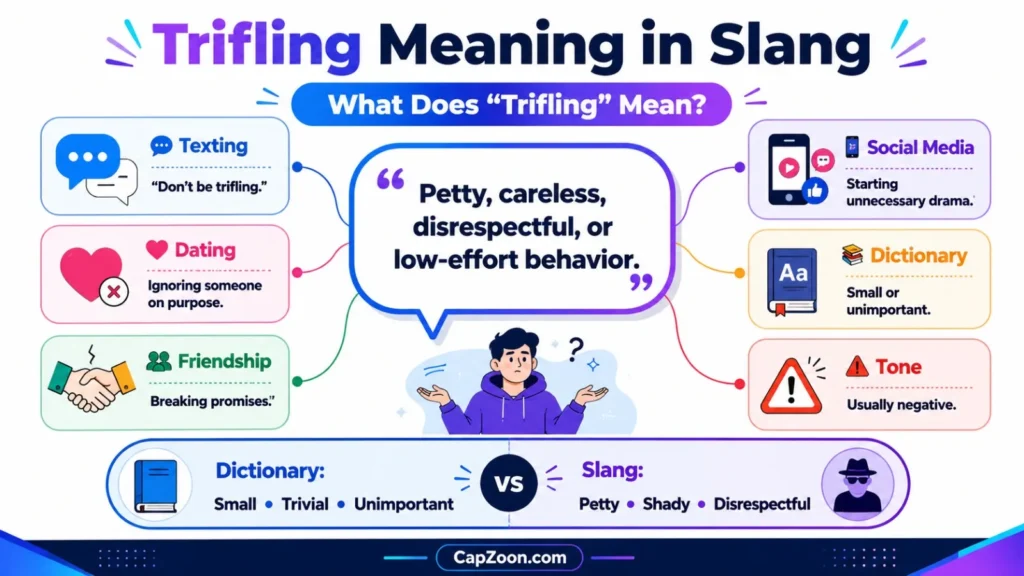
In slang, trifling means someone is acting in a low-effort, petty, shady, selfish, or disrespectful way. It is often used to criticize behavior that wastes someone else’s time, energy, or feelings.
In other words, if a person is being trifling, they are not being serious, honest, or respectful. The word usually carries a negative tone and can feel more personal than words like small or trivial. That negative edge matches the way major dictionaries describe its stronger senses and related meanings.
Quick Meaning Summary
| Use Case | Meaning |
| Dictionary meaning | Small, trivial, unimportant |
| Slang meaning | Petty, shady, careless, disrespectful |
| Tone | Negative, judgmental, informal |
| Common setting | Texts, arguments, social media, casual speech |
Dictionary Meaning vs. Slang Meaning
| Type | Meaning | Tone | Example |
| Dictionary usage | Something with little importance or value | Neutral | “a trifling matter” |
| Slang usage | A person or action that feels messy, selfish, or disrespectful | Negative | “That was trifling behavior” |
The dictionary side of the word is easy to understand: it points to something minor, slight, or not worth much attention. Merriam-Webster, Cambridge, and Dictionary.com all support that core idea.
The slang side is more emotional. It does not just mean “small.” It usually means the behavior is so annoying or unfair that it deserves criticism. Merriam-Webster’s note about the dialectal sense “lazy, shiftless” shows that the word has long been associated with judgment about character, not just size or importance.
Origin and History
The word trifling comes from trifle. Etymology sources trace it back to late Middle English, with trifling appearing as a verbal noun related to trifle and recorded from the late 14th century. The older sense was tied to lightness, frivolity, and wasting time rather than seriousness.
That history matters because it explains why the word still feels dismissive today. Even when people use it in slang, the idea behind it is similar: something or someone is being treated as not worth Much Respect, effort, or concern. This is an inference from the historical senses and modern dictionary meanings.
Is “Trifling” Popular in Text and Social Media?
Yes. Trifling still shows up in texts, comments, and posts because it is short, sharp, and expressive. It works well when someone wants to call out behavior without writing a long explanation.
In text slang, it usually means:
- petty
- disrespectful
- fake
- unreliable
- low-effort
That makes it useful in casual communication, especially when someone wants to express frustration quickly.
How Is “Trifling” Used in Text?
People often use trifling as a fast judgment in texting. It can describe a person, a choice, a message, or a situation.
Examples:
- “You said you were coming and never showed up. Trifling.”
- “That reply was trifling.”
- “Don’t be trifling in my messages.”
- “He borrowed my charger and never gave it back. Trifling.”
In these examples, the word is not describing size or importance. It is calling out behavior that feels disrespectful, careless, or shady.
Examples of Trifling in Real Life
Friendship
“You ate my food after saying you weren’t hungry? Trifling.”
Dating
“He kept promising to call and never did. Trifling.”
School or work
“She copied the assignment and acted like it was original. Trifling.”
Social media
“Posting drama after acting innocent is trifling behavior.”
Is “Trifling” an Insult?
Yes, it can be. In most modern casual usage, trifling is negative. It can sound like a mild-to-strong insult depending on the situation and the relationship between speakers.
Sometimes friends use it jokingly, but the word still keeps its critical edge. Because of that, it is best to treat it as an informal word with a negative tone rather than a neutral label. This fits both modern dictionary senses and the word’s historical use as something not serious or not worthy of respect.
Trifling vs. Petty
These words overlap, but they are not the same.
Petty usually means small-minded or overly focused on little things.
Trifling usually suggests something is careless, shady, disrespectful, or low-value.
That is why trifling often sounds harsher. It is not only about being small; it is about being poorly done or poorly behaved.
Trifling vs. Disrespectful
Disrespectful is more direct and formal.
Trifling is more slangy and conversational.
If you want a clean, professional word, use disrespectful. If you want a casual word with a sharper tone, trifling fits better.
Common Misunderstandings
A common mistake is thinking trifling only means “small.” That is the dictionary meaning, but in slang the word is more personal and more judgmental. Another misunderstanding is assuming it is always a very old-fashioned word. It is old, yes, but it still appears in modern casual speech because it is Short and Expressive.
Related Terms and Similar Meanings
Depending on the situation, trifling can overlap with:
- petty
- shady
- careless
- irresponsible
- unreliable
- inconsiderate
- unprofessional
- low-effort
- trivial
- insignificant
People Also Ask
A: It means the person is acting petty, careless, disrespectful, or shady. In slang, it is usually a negative judgment, not a compliment.
A: Not exactly. Petty usually means small-minded or focused on minor issues, while trifling often sounds more disrespectful or low-value.
A: It is not profanity, but it is usually negative. It can sound insulting depending on the tone and situation.
A: In a text, it usually means someone’s behavior is childish, careless, fake, or not worth respecting.
A: It comes from trifle and has been used in English since the late 14th century. The older sense was connected to something light, frivolous, or unimportant.
Conclusion
The trifling meaning in slang goes far beyond its traditional dictionary definition. While dictionaries describe trifling as something small, insignificant, or trivial, modern slang uses it to call out behavior that is petty, careless, disrespectful, shady, or simply not worth your time. Whether you see the word in a text message, on TikTok, Reddit, X (Twitter), or during everyday conversations, it almost always carries a negative tone.
Understanding the difference between the dictionary meaning and the slang meaning helps you interpret conversations More Accurately and use the word naturally in the right context. If someone says, “Don’t be trifling,” they’re usually criticizing someone’s attitude or actions—not saying something is small or unimportant.
As language continues to evolve through social media and online culture, words like trifling take on new meanings while still retaining their historical roots. Bookmark this guide whenever you need a quick explanation, and explore our other slang meaning articles to stay up to date with the latest internet vocabulary and texting expressions.