
Introduction
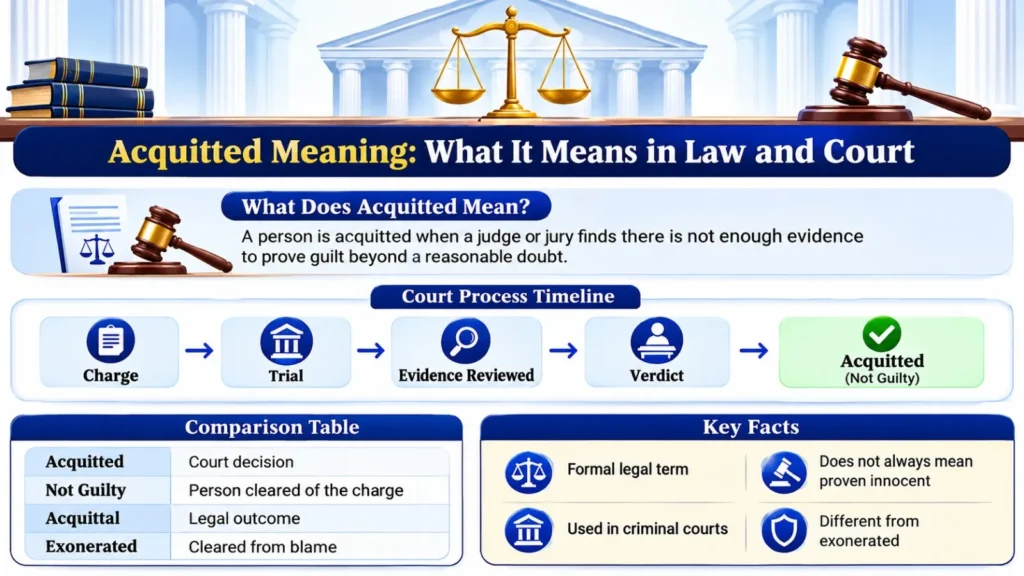
The word acquitted is most often used in law, especially in criminal court. In simple terms, it means a court has decided that a person is not guilty of the charge, or more precisely, that the prosecution did not prove guilt strongly enough for a conviction. Merriam-Webster defines acquit as discharging someone completely from an accusation, and Cornell Law explains that acquittal is a formal finding that the prosecution failed to prove guilt beyond a reasonable doubt.
People also search for Acquitted Meaning because the word appears in news reports, legal articles, and court discussions. It is a formal term, not slang, and it can sometimes be confusing because it sounds similar to not guilty, acquittal, and exonerated. This guide breaks the word down in plain English so readers can understand the legal meaning, the difference between related terms, and how to use it correctly.
Quick Meaning Summary
| Term | Simple Meaning | Best Use |
| Acquitted | Cleared of a charge by a court | When talking about a person and the court outcome |
| Acquittal | The legal result or ruling | When talking about the court decision itself |
| Not guilty | Verdict that the charge was not proven | When referring to the verdict |
| Exonerated | Cleared from blame or accusation | When emphasizing complete clearing of blame |
This summary reflects standard dictionary and legal usage: acquit means to release or discharge someone from an accusation, acquittal is the legal setting free from a charge, and exonerate means to clear from accusation or blame.

What Does Acquitted Mean?
In simple English, acquitted means a court has formally cleared someone of a criminal charge. Cambridge Dictionary defines it as an official court decision that someone is not guilty of a particular crime. Merriam-Webster also gives the core meaning as being discharged completely from an accusation.
What Does Acquitted Mean in Court?
In court, acquitted means the judge or jury did not find enough proof to convict the defendant. Cornell Law’s Legal Information Institute explains that acquittal is a not-guilty finding based on insufficient proof beyond a reasonable doubt. In other words, the prosecution did not meet the legal burden required for conviction.
That does not automatically mean the person was proven innocent. It means the evidence was not enough for the court to convict. That distinction matters in legal writing, news reporting, and search intent because many people use “acquitted” as a short way to say “found not guilty,” while the legal meaning is more precise.
Acquitted vs Not Guilty
These two phrases are closely related, but they are not identical in tone or function.
Not guilty is the verdict.
Acquitted is the result of being cleared by the court.
A simple way to remember it:
- Not guilty = the verdict
- Acquitted = the person was formally cleared
This is why legal writers often use both expressions in similar contexts, but acquitted sounds more formal and court-specific.
Acquitted vs Acquittal
Acquitted is the verb or adjective form used for a person:
The jury acquitted the defendant.
Acquittal is the noun form used for the ruling or outcome:
The defendant received an acquittal.
Acquitted vs Exonerated
These words are similar, but they are not the same.
- Acquitted usually refers to a formal court decision in a criminal case.
- Exonerated means cleared from accusation or blame, and Merriam-Webster notes that it implies complete clearance from a charge or suspicion.
So, exonerated can sound broader, while acquitted is the more precise legal term when talking about a court verdict.
Simple Examples of Acquitted
Here are clear example sentences:
- The jury acquitted him after the prosecution failed to prove the case.
- She was acquitted of all charges.
- The court acquitted the defendant in the criminal trial.
- He acquitted himself well during the debate.
The last example uses a less common meaning of acquit: to conduct or behave oneself satisfactorily, especially under pressure. Merriam-Webster and Collins both record this older, non-court meaning.
Is Acquitted a Formal Word?
Yes. Acquitted is a formal legal word used in court reporting, legal writing, and dictionary definitions. It is not a Slang Term, and readers usually encounter it in serious legal or news contexts rather than casual texting.
Common Misunderstandings
One common mistake is thinking acquitted means “proved innocent.” Legal references do not define it that way. They define it as a not-guilty outcome because the evidence was not enough to establish guilt beyond a reasonable doubt.
Another misunderstanding is treating acquitted and exonerated as perfect synonyms. They overlap, but exonerated focuses on clearing blame, while acquitted usually refers to a formal court result.
Related Terms and Similar Meanings
The closest terms to acquitted meaning are:
- acquit
- acquittal
- not guilty
- exonerated
- cleared
- vindicated
- absolved
These words all relate to removing blame or charges, but the legal force and context can differ. Acquitted remains the Most Direct Court-Related Term.
People Also Ask
A: It means the court cleared the person of the charge. In legal language, the defendant was not convicted because the prosecution did not prove guilt strongly enough.
A: Not always. The legal meaning is that the person was not proven guilty beyond a reasonable doubt, not that innocence was officially proven.
A: Acquitted refers to the person or the action of clearing them. Acquittal is the noun for the legal outcome or decision.
A: They are very closely related. Not guilty is the verdict, while acquitted describes the person being formally cleared by the court.
A: Yes. In older or more formal English, it can also mean to conduct oneself well, as in “he acquitted himself well.”
Conclusion
Understanding the meaning of “acquitted” is important because courts and news reports frequently use this legal term. In simple words, “acquitted” means a judge or jury decides that the prosecution failed to prove a person’s guilt beyond a reasonable doubt. Although an acquittal leads to a not guilty verdict, it does not necessarily prove the person was innocent. Instead, it means the prosecution did not meet the legal standard required for a conviction.
Knowing the difference between acquitted, not guilty, acquittal, and exonerated helps you interpret legal news, court cases, and legal documents more accurately. Whether you searched for what does acquitted mean, acquitted meaning in law, or acquitted vs not guilty, you now have a Clear Understanding of the term, its legal significance, and its correct usage. Explore more legal and dictionary meaning guides on Capzoon to build your vocabulary and better understand commonly used legal terms.