Kroner Meaning Understanding
If you have seen the word kroner and wondered what it means, the simplest answer is this: kroner is the plural form of krone, and it refers to the currency used in Norway and Denmark. Merriam-Webster defines krone as the basic monetary unit of Denmark and Norway, and notes that the word literally means “crown.” Cambridge also lists the English pronunciation of krone as /ˈkrəʊ.nə/ in British English and /ˈkroʊ.nə/ in American English.
People search for Kroner Meaning in English because the word appears in travel receipts, menus, exchange-rate pages, shopping sites, and finance articles. In those situations, it is important to know both the language meaning and the currency meaning. That is why a useful guide should explain krone vs kroner, the difference between Norwegian krone and Danish krone, and the currency codes NOK and DKK.
Quick Meaning Summary
| Question | Simple Answer |
| What does kroner mean? | It is the plural of krone. |
| What does krone mean in English? | Crown. |
| Is kroner singular or plural? | Plural. |
| Which countries use it? | Norway and Denmark. |
| What are the currency codes? | NOK for Norway and DKK for Denmark. |
What Does Kroner Mean?
Kroner means the plural form of krone. In currency use, it refers to the money used in Norway and Denmark. Merriam-Webster states that krone is the basic monetary unit of both countries and gives the word history as “literally, crown.”
Kroner Meaning in English
In English, krone is commonly translated as crown. That crown connection is why related currencies across Europe share similar names. Merriam-Webster notes that crown-themed currency names historically appeared in several European countries, including krone, krona, and koruna forms.
Is Kroner Singular or Plural?
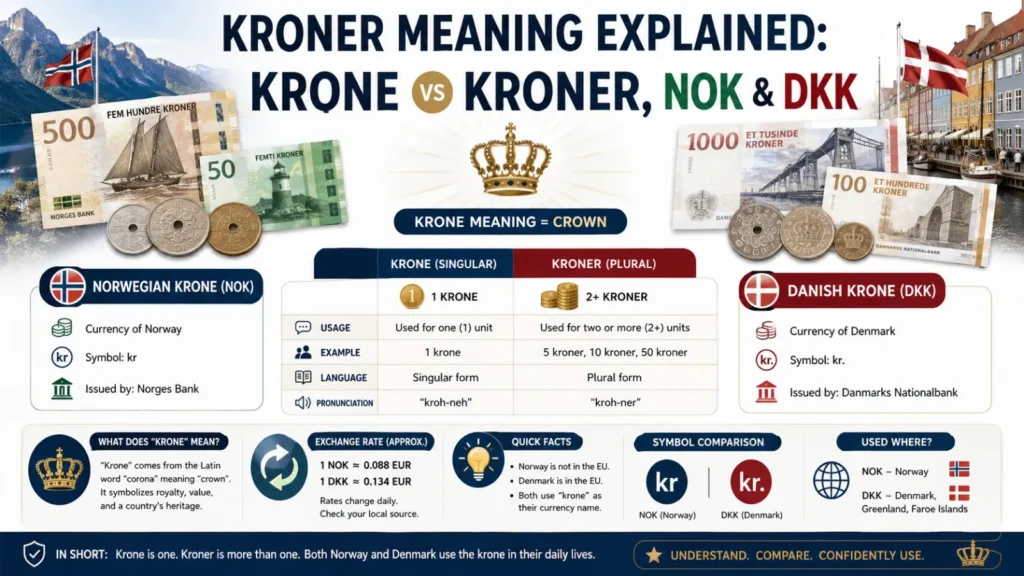
Kroner is plural.
Krone is singular.
So, you would say:
- 1 krone
- 2 kroner
- 50 kroner
Merriam-Webster explicitly lists krone with the plural kroner, which makes this one of the most important grammar points to get right in your article.
Krone vs Kroner: What Is the Difference?
The difference is simple:
- Krone = singular
- Kroner = plural
This is the same kind of change English makes with words like coin/coins or note/notes. In currency writing, the singular-plural difference matters because people often search the wrong form first and need a Clear Explanation.
Norwegian Krone Meaning and NOK
The Norwegian krone is the currency of Norway. Norges Bank states that the Norwegian krone (NOK) is Norway’s currency, and its official exchange-rate pages treat NOK as the currency code. Norges Bank also uses 1-krone in its legal-tender pages, which confirms the singular form in real currency usage.
A practical takeaway is this: when someone says NOK, they are usually talking about the Norwegian krone. In everyday writing, you may also see the symbol kr.
Danish Krone Meaning and DKK
The Danish krone is the currency of Denmark. Danmarks Nationalbank refers to the currency as Danish kroner and publishes exchange rates in Danish kroner, while ISO currency code lists identify DKK as Denmark’s currency code. Nationalbank also states that Denmark keeps the krone stable against the euro through its fixed exchange-rate policy.
So, when people search for DKK meaning, they are usually asking about the Danish krone. That is why a strong article should separate NOK and DKK instead of treating kroner as one single currency everywhere.
Why Does Krone Mean “Crown”?
The word krone comes from the idea of a crown. Merriam-Webster’s word history says the term is literally “crown,” and its related currency article explains that many European monarchies used crown-based names for their money. That makes the term both linguistic and historical.
This is also why similar currency names appear in nearby languages, such as krona and koruna. The naming pattern reflects royal symbolism and a shared European currency history.
How Kroner Is Used in Real Life
You will usually see kroner in everyday money contexts such as prices, receipts, exchange-rate pages, banknotes, and travel spending. Norges Bank and Danmarks Nationalbank both publish official exchange-rate information for their currencies, showing that kroner is not just a dictionary term; it is a working currency word used in real Financial Systems.
Common Mistakes People Make
Many readers confuse:
- krone and kroner
- NOK and DKK
- crown as a literal object versus crown as a currency origin
Another common mistake is assuming kroner is singular. It is not. The singular form is krone.
Examples of Kroner in Sentences
- I paid 20 kroner for coffee.
- The ticket costs 100 kroner.
- One coin is worth 1 krone.
- The exchange rate for NOK changes every day.
People Also Ask
A: It usually means crowns in a literal sense, and in money terms it refers to the currency used in Norway and Denmark.
A: It can be both. NOK is the Norwegian krone, and DKK is the Danish krone.
A: Krone is singular, and kroner is plural.
A: It means crown.
A: Cambridge lists the pronunciation as /ˈkrəʊ.nə/ in British English and /ˈkroʊ.nə/ in American English.
Conclusion
Understanding kroner meaning is simple once you Remember the key difference: krone is the singular form, while kroner is the plural form. The word comes from the meaning “crown” and is used as a currency term in Scandinavian countries, especially Norway and Denmark.
When you see prices written in kroner, they are usually referring to either the Norwegian krone (NOK) or the Danish krone (DKK). Knowing the difference between these currencies helps avoid confusion when traveling, shopping online, reading financial information, or converting money.
In short, kroner means “crowns” in English and represents units of Scandinavian currency. Whether you are learning a new language, planning a trip, or researching currency terms, understanding krone vs kroner, pronunciation, and country differences gives you a complete picture of this commonly used word.