Sybau Meaning Slang
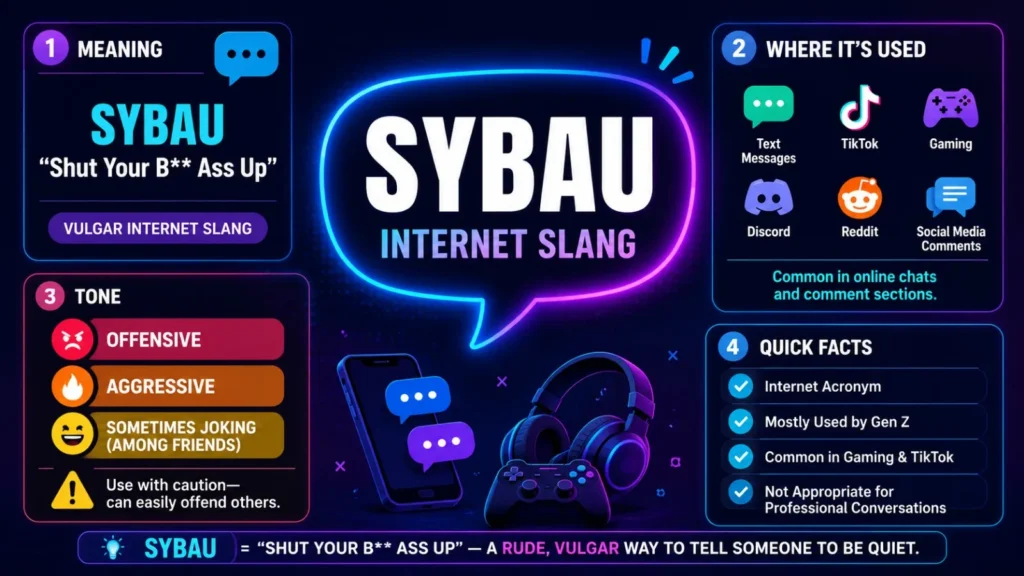
SYBAU is a modern internet slang abbreviation that most commonly means “shut your bitch ass up.” It shows up in texts, TikTok comments, online arguments, and gaming banter, where people use it as a blunt, rude, or joking way to tell someone to be quiet. Merriam-Webster defines it as “an angrier way to say ‘shut up’ online,” while Parade and Parents.com explain that it is often used by teens and tweens, sometimes as a joke and sometimes as a real insult.
That is why people search for this phrase so often. The term is short, hidden behind initials, and easy to misinterpret. Some users see it in a TikTok comment and want the meaning immediately. Others hear it spoken and are unsure how to pronounce it. Parents may see it in a text and wonder whether it is harmless slang or a disrespectful insult. This guide answers all of that clearly: what SYBAU means, how it is used, where it appears, how to say it, and why it should be treated as offensive in most situations.
Quick Meaning Summary
| Item | Summary |
| Meaning | SYBAU means “shut your bitch ass up.” |
| Tone | Rude, aggressive, and sometimes joking between friends. |
| Common use | Text messages, TikTok comments, online arguments, and gaming banter. |
| Risk | Offensive language that can easily sound disrespectful. |
What Does SYBAU Mean?
SYBAU is an internet slang initialism. The most widely accepted meaning is “shut your bitch ass up.” Merriam-Webster lists it as an abbreviation and calls it “an angrier way to say ‘shut up’ online,” while Wiktionary classifies it as internet slang, text messaging slang, and vulgar language.
In simple English, SYBAU is a harsh way of shutting someone down. People usually use it when they are annoyed, trying to end an argument, or making a joke that still carries a sharp edge. In other words, it is not a neutral acronym. It is a rude comeback.
Is SYBAU Offensive?
Yes, SYBAU is offensive. It contains vulgar language, and the phrase is usually used as a put-down. Parents.com describes it as disrespectful, and Merriam-Webster notes that it often appears in online arguments with genuine hostility, even if it is sometimes used tongue-in-cheek.
The tone depends on context, but the safest assumption is that it can sound rude fast. Parade notes that some teens use it jokingly among friends or as a quick comeback in gaming, yet that does not remove the offensive wording.
Where Did SYBAU Come From?
The exact origin is not fully pinned down, but Merriam-Webster says evidence of SYBAU dates back more than 20 years. Wiktionary also shows Modern examples on X from 2022 and 2024, which supports the idea that the term has lived in internet slang for years and later reappeared in newer social spaces.
Like many slang abbreviations, it spread through online communities first and then became more visible on social platforms. Today it is especially associated with fast-moving internet speech, teen texting, and comment-section culture.
How to Pronounce SYBAU
There is no single official pronunciation, but Parents.com says the most common versions include “see-bow,” “sigh-bow,” and “sea-brow.” That is one reason the term can confuse people when it is spoken instead of written.
How Is SYBAU Used in Text?
In text messages, SYBAU usually acts like a blunt comeback. It may be used to dismiss a comment, shut down a conversation, or respond with attitude. Parade describes it as a modern version of “STFU” that can be used in banter between friends or in a heated exchange.
Text examples
- “SYBAU, nobody asked.”
- “He replied with SYBAU after the argument got heated.”
- “Don’t start with me — SYBAU.”
These examples show the basic pattern: short, direct, and dismissive. In real use, it often carries frustration, sarcasm, or mock aggression.
SYBAU on TikTok and Social Media
SYBAU is especially visible on TikTok. Capital FM says it is used in comment sections and can help users avoid getting flagged, censored, or shadow-banned because the phrase is shortened into initials. Parade and Parents.com also show that the term spreads through teen social media culture, where adults are sometimes deliberately given fake meanings like “Stay young, beautiful and unique.”
That makes SYBAU a good example of algospeak-style internet language: people use initials, abbreviations, or coded phrasing to get around moderation or to keep meaning inside a peer group. On TikTok, that can make the phrase feel like part joke, part insult, and part in-group code.
SYBAU in Gaming
Gaming is another common place where SYBAU appears. Parade explains that teens may use it as a quick comeback after beating another player or as back-and-forth banter with friends. In gaming chat, the phrase can come across as trash talk, especially after a win, a clutch play, or a heated match.
Still, the same warning applies: if the other person does not share the joke, the phrase can sound rude, toxic, or disrespectful. In public lobbies and mixed-group chats, it is safer to avoid it.
SYBAU vs STFU vs Shut Up
These three expressions are related, but they are not identical.
Shut up is the mildest.
STFU is stronger and more aggressive.
SYBAU is the most vulgar because it includes an explicit insult. Merriam-Webster and Parade both frame SYBAU as a harsher online version of “shut up,” while Parade compares it to STFU-style banter.
Common Misunderstandings
One of the biggest misunderstandings is the fake friendly meaning that some kids use around adults. Parents.com reports that children may claim SYBAU means “Stay Young, Beautiful and Unique,” which is part of the joke and part of the misdirection. Parade says similar false meanings are used to confuse adults and keep the slang inside the group.
Another misunderstanding is the idea that a joking tone makes the phrase harmless. It does not. Even when it is used playfully, the wording is still vulgar and can easily offend someone who is outside the joke.
Related Terms and Similar Meanings
If you are decoding SYBAU, you may also come across other short internet phrases that depend heavily on context. The Guardian’s 2026 explainer groups SYBAU with other modern teen abbreviations like WYLL and PMO, showing how quickly online language changes and how many meanings can sit behind just two or three letters.
Other related terms that often appear in the same slang ecosystem include:
- STFU — a harsher version of “shut up”
- WYLL — “what you look like”
- PMO — “put me on” or “pisses me off,” depending on context
- algospeak — coded language used online to avoid moderation or to communicate indirectly.
People Also Ask
A: It usually means “shut your bitch ass up.” It is a vulgar, dismissive reply used in texting, comment sections, or online arguments.
A: Yes. It is offensive, rude, and vulgar, even when someone uses it jokingly.
A: On TikTok, it is often used in comments or banter, and some users shorten it to avoid moderation or censorship.
A: Common pronunciations reported by Parents.com include “see-bow,” “sigh-bow,” and “sea-brow.”
A: They are similar, but SYBAU is more explicitly vulgar and often feels harsher.
Conclusion
SYBAU is a vulgar internet slang abbreviation that stands for “shut your bitch ass up.” It is widely used in text messages, TikTok comments, gaming chats, and other social media platforms as a blunt way to tell someone to be quiet. While some friends use it jokingly during Playful banter, the phrase still contains offensive language and can easily come across as disrespectful or aggressive.
Understanding the SYBAU meaning is important because internet slang evolves quickly, and abbreviations often spread far beyond the communities where they first appeared. Whether you came across it in a text, a TikTok video, a Discord server, or an online game, the key takeaway is that SYBAU is generally considered rude and should be used with caution. It is not appropriate for professional conversations, school or workplace communication, or situations where respectful language matters.
As new slang terms continue to trend online, knowing both their literal meaning and the context in which they are used helps you communicate more confidently and avoid misunderstandings. If you’re interested in decoding more internet abbreviations, explore our related guides on modern texting slang, TikTok acronyms, and social media terminology to stay up to date with the latest online language.