Introduction
If you have seen ICL in a text, comment, or caption and felt confused, you are not alone. In modern internet slang, ICL most commonly means “I can’t lie.” It is a short, casual way to introduce an honest opinion, a blunt reaction, or a real feeling. In other words, the phrase signals that the speaker is about to be truthful. Slang references and social-platform explainers describe it as common online shorthand, especially in casual chat spaces such as TikTok, Snapchat, and Twitter/X.
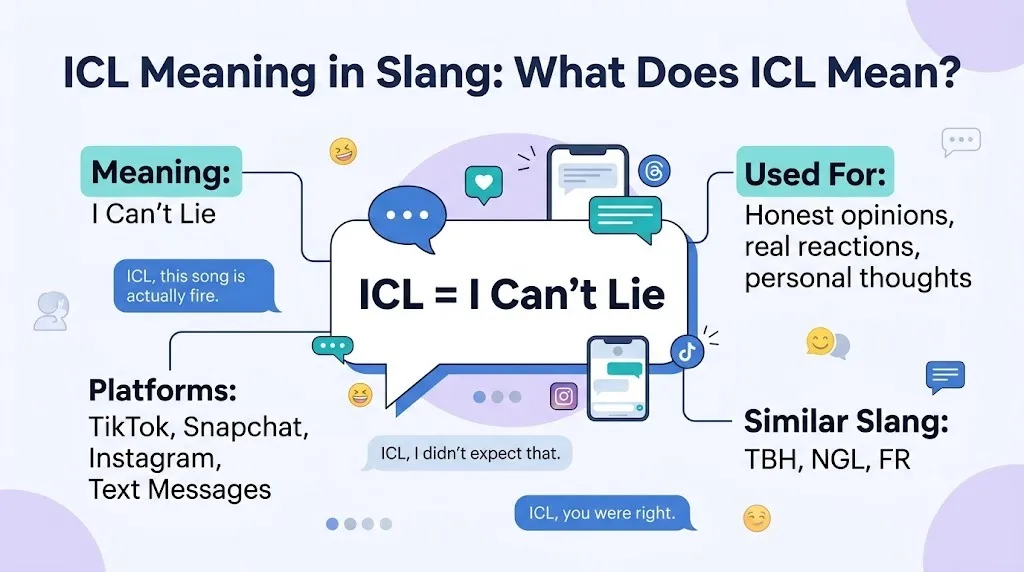
That is why ICL often appears in messages like “ICL, that song was actually fire” or “ICL, I did not expect that ending.” It works much like other honesty markers such as TBH and NGL, but it can feel a little more direct and conversational.
What Does ICL Mean in Slang?
ICL = I can’t lie.
It is used before a statement to show that the speaker is being honest, blunt, or emotionally real. Slang.net describes it as a way to emphasize the truth of what follows, and Wiktionary labels it internet slang with an example in use on Twitter/X.
Quick Meaning Summary
| Term | Meaning | Tone | Best Use |
| ICL | I can’t lie | Honest, casual, direct | Texts, captions, comments |
| TBH | To be honest | Honest, reflective | Casual opinions |
| NGL | Not gonna lie | Casual, softens honesty | Reactions and opinions |
| FR | For real | Strong agreement | Replies and emphasis |
ICL is especially useful when someone wants to share a real opinion without sounding too formal. It can make a sentence feel more natural and human in fast online conversation.
Why ICL Became Popular
ICL became popular because internet language rewards speed, personality, and short expressions. A compact phrase like “I can’t lie” is easier to type as ICL, especially in comment threads, DMs, and quick reactions. Current slang references place it in social media use, and Snapchat’s topic page also frames it as part of viral internet shorthand.
A useful way to think about ICL is this: it is a tiny honesty signal. It does not change the meaning of the sentence completely, but it changes the tone. The speaker sounds more direct, more casual, and often more authentic. That tonal shift is a big reason the term fits so well in short-form online culture.
Origin and History
There is not a single widely cited “first use” date for ICL, but major slang references clearly treat it as internet slang and document it in online conversation by at least 2019. Wiktionary includes a 2019 Twitter example, which shows that the shorthand was already in casual use by then.
So, while the exact origin is not neatly pinned down in major references, the modern meaning is clear: ICL is a shorthand way to say “I can’t lie.”
How Is ICL Used?
ICL is used before a statement when someone wants to sound honest or spontaneous. It often appears before praise, criticism, surprise, or a personal confession.
Good examples
- ICL, that movie was actually amazing.
- ICL, I did not expect that ending.
- ICL, this outfit looks really good.
- ICL, I was nervous at first.
In each case, the phrase adds a conversational “truthful” tone. It makes the sentence feel less stiff and more like real speech.
ICL Meaning on TikTok
On TikTok, ICL usually means “I can’t lie.” Slang.net specifically notes its use on TikTok, Twitter/X, and Snapchat, where people use it to preface a blunt or sincere comment. TikTok-style usage often appears in reactions, captions, and comments.
TikTok-style examples
- ICL, this trend is Actually Funny.
- ICL, I thought this was going to be bad.
- ICL, that edit hit harder than expected.
ICL Meaning on Snapchat
On Snapchat, ICL also usually means “I can’t lie.” Snapchat’s topic page frames “What Does Icl Mean” as part of decoding internet lingo and viral shorthand, which reinforces how the term fits fast, casual messaging.
Snapchat-style examples
- ICL, you were right about that.
- ICL, I did not like that ending.
- ICL, that was actually funny.
ICL in Text Messages and Comments
In text messages, ICL works as a quick honesty marker. It is especially common when the sender wants to sound relaxed and real. In comments, it often introduces a blunt opinion or a genuine reaction. Slang references describe it as casual internet shorthand, not formal language.
Text message examples
- ICL, I miss the old version of the show.
- ICL, that was kind of hard to watch.
- ICL, I actually like this one better.
ICL vs TBH vs NGL vs FR
These terms are related, but they do not always feel identical.
| Acronym | Meaning | Typical Feel |
| ICL | I can’t lie | Direct and personal |
| TBH | To be honest | Calm and reflective |
| NGL | Not gonna lie | Casual and conversational |
| FR | For real | Strong agreement or emphasis |
ICL is often the most straightforward of the group. It gives the impression that the speaker is about to be honest right away. That makes it a strong choice for casual opinions and reactions.
Common Mistakes People Make
One common mistake is assuming that ICL can only mean one thing in every context. In slang-heavy conversation, I can’t lie is the safest meaning, but context still matters. Social references and slang entries show that abbreviations can shift meaning depending on the setting.
Another mistake is using ICL in formal writing. Because it is informal slang, it is better suited to texts, captions, comments, and casual chats. It does not belong in professional emails, academic writing, or official communication. That is a style judgment based on its documented use as internet slang.
Does ICL Have Other Meanings?
Yes. Context matters. Snapchat’s topic page mentions that ICL can also point to implantable collamer lens, which is a medical term, showing that the same letters can mean different things in different settings. That is why the surrounding conversation is so important.
In casual online conversation, though, ICL almost always means “I can’t lie.” That is the meaning readers are most likely looking for when they search this phrase.
Real Examples of ICL
Here are some natural examples you can use or model your article around:
- ICL, that was the Best Part of the show.
- ICL, I was not ready for that plot twist.
- ICL, this song is actually fire.
- ICL, I did not think it would be that good.
- ICL, you were right about that one.
These examples work because they sound like everyday online speech, which is exactly where the acronym is used most often.
People Also Ask
A: ICL means “I can’t lie.” It is used to introduce an honest or direct statement in casual conversation.
A: In text messages, ICL usually means “I can’t lie.” It often appears before a real opinion or personal reaction.
A: On TikTok, ICL usually means “I can’t lie.” People use it in captions, replies, and reaction comments to sound honest or authentic.
A: On Snapchat, ICL also usually means “I can’t lie.” It fits the app’s fast, informal chat style.
A: They are similar, but not the same. Both signal honesty, but ICL often feels more direct and personal, while NGL can feel a little softer. That difference is an inference from their common usage as honesty markers.
Conclusion
If you come across ICL in a text, TikTok comment, Snapchat message, or social media caption, it most commonly means “I can’t lie.” This popular internet slang abbreviation helps people introduce an honest opinion, personal reaction, or straightforward feeling in a quick and casual way.
Unlike formal expressions, ICL adds a conversational tone that makes messages feel more natural and authentic. It is often used in the same way as TBH (to be honest) or NGL (not gonna lie), but many users find ICL slightly more direct and personal.
Remember that context always matters. While ICL meaning in slang is usually “I can’t lie” in online conversations, the abbreviation may have different meanings in professional, medical, or specialized fields. Understanding where and how the term appears will help you interpret it correctly.
As internet language continues to evolve, abbreviations like ICL show how Digital Communication keeps becoming faster, shorter, and more expressive. Whether you see it on TikTok, Snapchat, Instagram, or in everyday texting, you can now confidently understand what ICL means and how to use it naturally.