ETC Meaning in Text
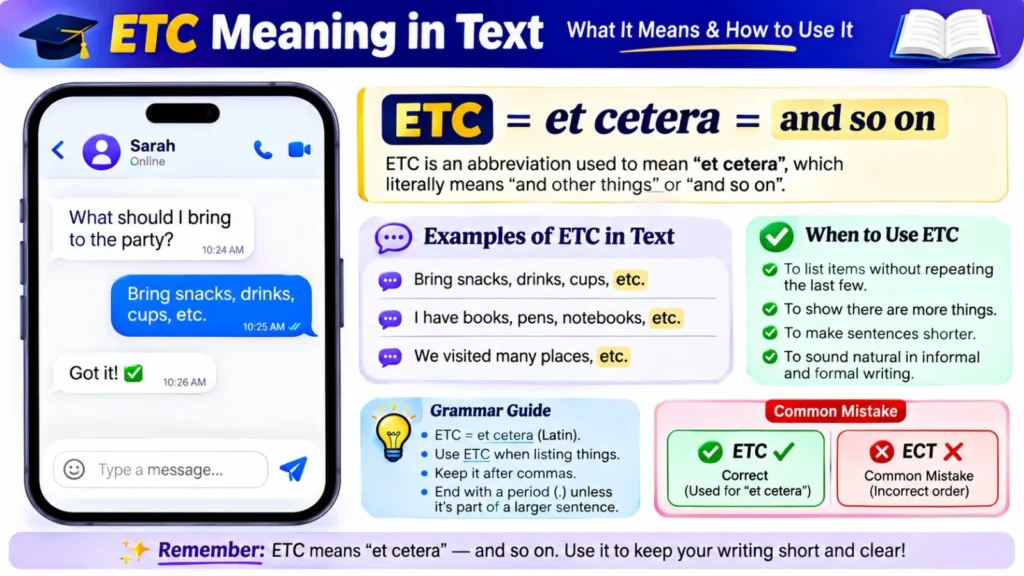
ETC Meaning in Text is simple: it is the abbreviation of et cetera, a Latin phrase that means “and the rest,” “and so on,” or “and other similar things.” People use it when they want to show that a list continues, but they do not need to name every item. That is why you will see etc. in texts, emails, captions, notes, and everyday writing. Cambridge defines it as “and other similar things,” while Grammarly and Canada.ca explain that it marks an incomplete list.
In texting, etc. works the same way it does in standard writing. The biggest reason people search for it is that they see it used after a list and want to know whether it is slang, an abbreviation, or a grammar rule. It is not internet slang. It is a long-used abbreviation that still appears in modern messages because it saves space and keeps writing concise.
What Does ETC Mean in Text?
ETC stands for et cetera, which means “and the rest.” In text, it signals that the list is not finished. For example: “Bring chips, drinks, plates, etc.” means there are more related items the writer is not naming one by one. Grammarly, QuillBot, and Cambridge all describe the same basic meaning.
Quick Meaning Summary
| Term | Meaning | Best Use |
| etc. | et cetera; and the rest | End of a related list |
| et cetera | full Latin phrase | Formal or explanatory writing |
| and so on | everyday English equivalent | Casual Explanations |
| ect | misspelling | Avoid |
| ECT | Separate abbreviation in other fields | Do not use for “etc.” |
Canada.ca specifically notes that ect. is a common error, and that etc. is the correct abbreviation.
Origin and History
Et cetera comes from Latin. Grammarly explains that et means “and” and cetera means “the rest.” Canada.ca also treats it as a normal part of English usage, not something that should be italicized.
How Is ETC Used in Text?
Use etc. when you have already given enough examples, and the reader can easily understand the pattern. QuillBot and Grammarly both say the items should belong to the same category, and the list should already contain at least two items.
Correct examples:
- “We packed sandwiches, juice, fruit, etc.”
- “The playlist has pop, rock, jazz, etc.”
- “She likes notebooks, pens, folders, etc.”
Incorrect examples:
- “Buy broccoli, light bulbs, etc.”
- “I got etc.”
- “and etc.”
Canada.ca also warns that etc. should not be used after such as or for example, because those phrases already show the list is incomplete.
ETC vs ECT
This section is one of the best ranking opportunities.
ETC is correct for et cetera.
ECT is usually a misspelling when people mean etc. Trinka explicitly says ect. has no recognized meaning in English in this context, and Canada.ca also calls it a common error.
Comparison
| Form | Correct? | Meaning |
| etc. | Yes | et cetera |
| ect | No | misspelling |
| ECT | Sometimes, but not here | Different abbreviation in other contexts |
Common Mistakes with ETC
The most common mistakes are:
- writing, etc.
- writing etc etc
- using ect instead of etc.
- using etc. after a weak or unrelated list
- adding etc. after such as or for example when it is not needed
Canada.ca says etc. should end with a period, and if it appears mid-sentence, punctuation may be needed before and after it depending on the sentence structure.
Is ETC Formal or Informal?
It can appear in both, but many style references recommend caution in formal writing. Grammarly notes that full lists are better when precision matters, and Canada.ca says some guides suggest avoiding etc. in formal writing altogether.
Use etc. in:
- chats
- Captions
- casual emails
- quick notes
- general explanations
Avoid it in:
- legal writing
- academic arguments
- technical documents where detail matters
- business writing that needs precision
Examples of ETC in Real Life
Text message: “I need snacks, water, cups, etc.”
Email: “Please send your ID, documents, receipts, etc.”
Caption: “Beaches, sunsets, road trips, etc.”
Class note: “Topics include grammar, punctuation, spelling, etc.”
These examples match the standard meaning described by Cambridge, Grammarly, QuillBot, and Canada.ca.
People Also Ask
A: It means et cetera, or and the rest. It shows that the list continues with similar items.
A: Yes, in everyday writing they usually mean the same thing. Cambridge and Grammarly describe the same basic idea in different wording.
A: Yes. Canada.ca says the abbreviation ends with a period.
A: No. That is redundant because et already means and. Grammarly explains the Latin breakdown directly.
A: etc. is correct; ect is a common mistake. Canada.ca and Trinka both flag ect as an error in this context.
Conclusion
The ETC meaning in text is simple yet useful to understand. ETC stands for et cetera, a Latin phrase meaning “and other similar things,” “and so on,” or “and the rest.” It is not internet slang but a standard abbreviation that people use in text messages, emails, social media captions, notes, and everyday writing to shorten a list of related items.
To use etc. correctly, place it at the end of a list of similar things, include the period, and avoid common mistakes such as writing “etc.” or confusing ETC with ECT. While etc. is perfectly acceptable in casual Communication, it is often better to list every item in formal or technical writing where precision is important.
Whether you spotted etc. in a chat, school assignment, work email, or social media post, you now know exactly what it means and how to use it with confidence. Understanding this small abbreviation can make your writing clearer, more concise, and grammatically correct. If you’re interested in learning more internet abbreviations, texting acronyms, and everyday English meanings, explore our other guides to build your vocabulary and communicate more effectively.