
Cool in Spanish Slang
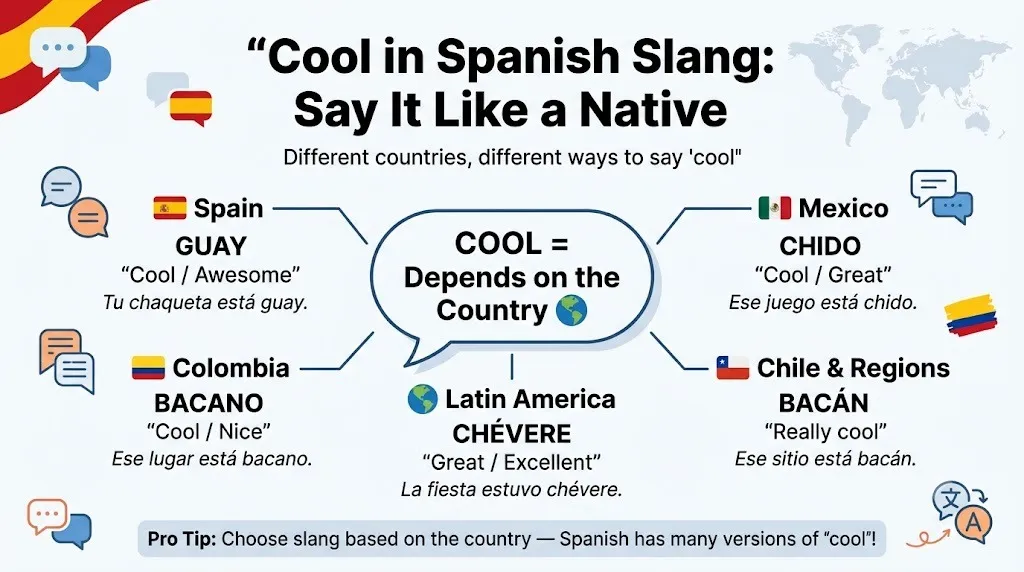
If you are searching for Cool in Spanish Slang, the first thing to know is that there is no single universal word that works everywhere. Spanish slang changes by country, and the “right” word depends on where you are speaking, who you are talking to, and how informal the situation is. The Royal Spanish Academy (RAE) clearly marks many of these words by region: guay in Spain, chido in Mexico, chévere across several Latin American countries, bacán in Chile, Colombia, Cuba, and the Dominican Republic, bacano in Colombia, and chingón as a strongly informal Mexican term.
That is why this topic deserves a guide that goes beyond a simple list. People are not only asking for a translation; they want to sound natural, avoid awkward mistakes, and choose the word that fits the country and the tone. In this article, you will get the fastest answer, the regional breakdown, real examples, common mistakes, and the safest fallback words when you are unsure.
What does “cool” mean in Spanish slang?
In Spanish slang, cool usually means “great,” “nice,” “awesome,” “very good,” or “stylish,” but the exact word changes by country. The RAE shows that these are not universal synonyms; they are regionally marked colloquial words with different normal usage zones. For example, guay is marked for Spain, chido for Mexico, chévere for several Latin American countries, and bacán for Chile, Colombia, Cuba, and the Dominican Republic.
Quick meaning summary
| Country/region | Best common word | Tone | Notes |
| Spain | guay | casual, everyday | RAE marks it as “muy bueno” in Spain. |
| Mexico | chido | casual, everyday | RAE marks it as Mexican colloquial Spanish. |
| Colombia, Venezuela, Peru, and others | chévere | casual, friendly | RAE marks it as “excellent / great” in several countries. |
| Chile, Colombia, Cuba, Dominican Republic | bacán | casual, youthful | RAE marks it as “very good” in youth language. |
| Colombia | bacano | casual | RAE links it to bacán. |
| Mexico | chingón | very informal, strong | RAE marks it as Mexican and vulgar/strongly informal. |
The fastest answer: cool by country
If you need the shortest possible answer, use this:
- Spain: guay.
- México: chido.
- Colombia / Venezuela / Peru / Central America / Caribbean areas where it is common: chévere.
- Chile / Colombia / Cuba / Dominican Republic: bacán.
- Colombia: bacano.
- Mexico, very informal: chingón.
If you do not know the country, a broad neutral word like genial is safer than a region-specific slang term. The RAE defines genial as something pleasant or outstanding, which makes it a useful fallback in many situations.
How to say cool in Spain
In Spain, the most recognizable slang answer is guay. The RAE marks it as colloquial Spanish meaning “muy bueno” and also as “Muy Bien” in adverbial use. The same entry also links it with nearby casual synonyms such as genial and chulo, showing how closely these everyday expressions sit together in Spain.
Examples:
- Tu chaqueta está guay.
- ¡Qué chulo tu coche!
- Esa idea está genial.
The word chulo is also useful in Spain when you mean “nice,” “pretty,” or “cute” in a casual way. The RAE marks this colloquial sense explicitly.
How to say cool in Mexico
In Mexico, chido is one of the most natural words for cool. The RAE marks it as Mexican colloquial Spanish and gives it the sense of “very good.” For something stronger and more emphatic, chingón is also used, but the RAE labels it as strongly informal and vulgar, so it fits casual speech rather than polite or formal conversation.
Examples:
- Ese juego está chido.
- Tu idea quedó chida.
- Ese músico es chingón.
For most learners, chido is the safer everyday choice. Chingón sounds more intense and more street-level, so it should be used carefully.
How to say cool in Colombia, Venezuela, Chile, Peru, and the Caribbean
One of the most widely recognized Spanish slang words for cool is chévere. The RAE marks it as meaning “estupendo, buenísimo, excelente” in the Antilles, Bolivia, Colombia, El Salvador, Honduras, Panama, Peru, and Venezuela. That makes it one of the best regional options when you want a friendly, positive word that works across multiple countries.
Another common regional word is bacán. The RAE labels it as “muy bueno” in youth language in Chile, Colombia, Cuba, and the Dominican Republic. The related form bacano is especially associated with Colombia, where the RAE links it directly back to bacán.
Examples:
- La fiesta estuvo chévere.
- Ese lugar está bacán.
- Tu foto quedó bacana.
For readers, this is the most important point: chévere is broader, while bacán / bacano are more location-sensitive. A strong article should help them choose the right one before they speak.
Other common Spanish words that can work like “cool”
Not every situation needs pure slang. Sometimes a broader word is better.
Genial is one of the safest options because it means great, excellent, or outstanding in standard Spanish.
Chulo is common in Spain in colloquial speech and can mean nice, pretty, or attractive depending on context.
Chanchi also appears in the RAE as a colloquial Spain-based positive word meaning very good. That makes it another useful Spain-specific item for a regional guide.
Comparison table: slang level and risk
| Word | Strength | Regional fit | Risk level |
| guay | everyday slang | Spain | Low if used in Spain, odd elsewhere. |
| chido | everyday slang | Mexico | Low in Mexico, less natural elsewhere. |
| chévere | friendly slang | several Latin American countries | Low to medium; broad but still regional. |
| bacán / bacano | youthful slang | Chile, Colombia, Cuba, Dominican Republic | Medium; best when region is known. |
| chingón | Very Strong Slang | Mexico | Higher; informal and potentially offensive in the wrong setting. |
| genial | neutral positive word | most places | Low; safest fallback. |
What not to say if you want to sound natural
The biggest mistake is treating one slang word as if it works in every Spanish-speaking country. The RAE’s regional labels show why that does not work: guay is Spain-specific, chido is Mexico-specific, bacano is Colombia-specific, and chingón is marked as strongly informal Mexican Spanish. A word can be correct and still sound out of place if the region is wrong.
A second mistake is confusing “cool” with “good” in every context. In Spanish, some words are more about approval, others about style, and others about admiration. That is why a regional guide is more useful than a basic translation list.
Real examples of cool in Spanish slang
- That concert was cool. → Ese concierto estuvo chévere.
- Your shoes are cool. → Tus zapatos están guay.
- This restaurant is cool. → Este restaurante está bacán.
- That idea is cool. → Esa idea está chida.
- Your plan is cool. → Tu plan está genial.
Quick usage guide
Utilize guay if the context is Spain. Apply chido if the context is Mexico. Use chévere when the audience is from countries where it is common. Use bacán / bacano when you know the audience is from the relevant countries. Utilize genial when you want a safe, neutral word that does not feel too regional.
Common misunderstandings
Is there one perfect word for “cool” in Spanish?
No. The best word depends on country and tone. The RAE’s regional labels make that clear.
Is chido standard Spanish?
No. It is colloquial Mexican Spanish.
Is chévere only used in one country?
No. The RAE lists it across multiple Latin American countries.
Can I use guay in Latin America?
It may be understood by learners, but it is most strongly associated with Spain.
Is chingón safe in every conversation?
No. It is strongly informal and marked as vulgar in the RAE, so it should be used carefully.
People also ask
A: There is no single universal answer. Guay is common in Spain, chido in Mexico, chévere in several Latin American countries, and bacán in Chile and some neighboring regions.
A: The RAE marks chido as colloquial Mexican Spanish, meaning very good. It is one of the most natural casual words for “cool” in Mexico.
A: The RAE defines chévere as excellent/great / very good in several Latin American countries, including the Antilles, Bolivia, Colombia, El Salvador, Honduras, Panama, Peru, and Venezuela.
A: The RAE marks bacán as very good in youthful language in Chile, Colombia, Cuba, and the Dominican Republic. It can also describe a very attractive person in some of those regions.
A: Genial is one of the safest broad options because it is not as region-specific as slang words like guay or chido.
Conclusion
There isn’t a single Spanish slang word that means “cool” everywhere. The most natural choice depends on the country, the people you’re talking to, and the situation. Guay is the go-to slang term in Spain, chido is widely used in Mexico, chévere works across many Latin American countries, while bacán and bacano are popular in specific regions such as Chile and Colombia. If you’re unsure which regional slang to use, genial is a safe and widely understood alternative.
The easiest way to sound more like a native speaker is to match your vocabulary to the local dialect instead of relying on one universal translation. By understanding where each expression is commonly used, you’ll communicate More Naturally whether you’re traveling, chatting with friends, watching Spanish-language content, or learning the language.
Bookmark this guide whenever you need the right way to say cool in Spanish slang, and explore our other Spanish slang articles to expand your vocabulary with authentic, everyday expressions used across the Spanish-speaking world.