Introduction
If you have seen ISTG in a text, DM, caption, or comment and stopped to decode it, you are not alone. In modern online communication, ISTG most commonly means “I swear to God.” It is a shorthand way to show honesty, frustration, surprise, seriousness, or strong emotion. Dictionary.com defines it this way and notes that it is usually used outside a serious religious context, while slang dictionaries and current slang guides describe it as a common internet abbreviation used for emphasis.
What makes ISTG interesting is that it is not tied to just one mood. In one message, it can sound sincere and emphatic. In another, it can sound dramatic, sarcastic, or annoyed. That is why context matters so much. On current slang pages, ISTG is repeatedly explained as something people use in casual text conversations, social media replies, captions, and chat threads, especially when they want the reader to feel the emotion behind the words.
What Does ISTG Mean?
ISTG stands for I swear to God. It is an abbreviation used in informal digital conversation to add weight to a statement. Current dictionary and slang sources describe it as a way to show extreme seriousness, exasperation, surprise, honesty, or emphasis.
Quick meaning summary
| Term | Full form | Core meaning | Common tone |
| ISTG | I swear to God | Strong emphasis | Serious, emotional, dramatic |
| FR | For real | Agreement or confirmation | Casual, direct |
| ONG | On God | Strong emphasis | Intense, confident |
| OMG | Oh my God | Shock or surprise | Reaction-based |
ISTG is often stronger than simple agreement slang like FR because it adds more emotion and urgency. It can also feel more personal than generic reaction slang like OMG.
ISTG Full Form in Text
The full form is simple:
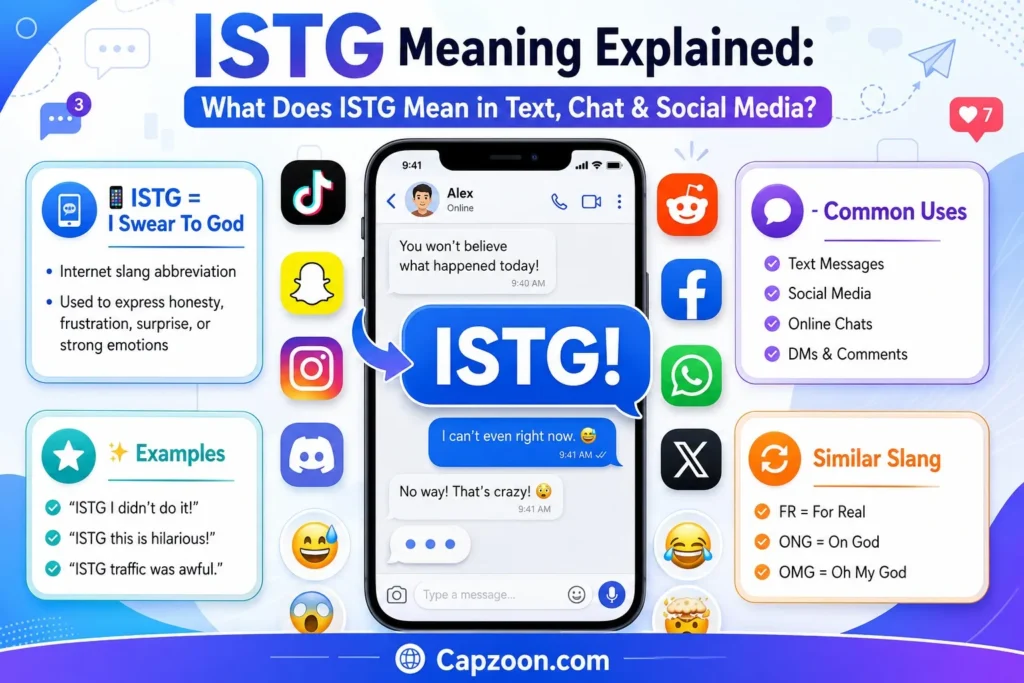
ISTG = I swear to God.
In real texting, people usually do not mean it as a formal religious statement. Instead, they use it to stress that they are being honest, to react strongly, or to make a message feel more intense. That is why many modern slang guides describe it as an emphasis tool rather than a literal promise.
ISTG Meaning in Chat
In chat, ISTG works like an emotional amplifier. It gives a message more force and helps the sender sound believable, frustrated, shocked, or playful depending on the sentence around it. AllSimiles and GrammarSpots both show ISTG being used in casual conversation where tone is important, while Dictionary.com notes the seriousness, exasperation, and surprise angle.
Chat examples
- “ISTG, I did not take your charger.”
- “ISTG this exam was brutal.”
- “ISTG you are making me laugh too hard.”
- “ISTG if this happens again, I am done.”
These examples show why ISTG is so common in texting: it saves time and adds tone at the same time.
ISTG Meaning on Snapchat, TikTok, and Instagram
ISTG is especially popular on social platforms because short, expressive language performs well in comments, captions, and replies. Current slang pages and platform search results place ISTG across Instagram, TikTok, Snapchat, and other online spaces.
On Snapchat
ISTG often appears in quick one-to-one messages where people are reacting fast, being dramatic, or defending themselves.
On TikTok
ISTG is common in captions and comments when creators want to say, “this really happened,” or when viewers want to react strongly to a video.
On Instagram
ISTG often shows up in captions and comments to add personality, humor, shock, or emphasis.
On X/Twitter, Discord, and Reddit
ISTG can work in Fast Reactions, joke replies, or intense opinions where a short emotional phrase fits the pace of the conversation.
Is ISTG Rude?
ISTG is not automatically rude, but it can sound intense. Dictionary.com says it is usually used outside a serious religious context, and GrammarSpots warns that the tone can become too harsh in the wrong setting. In other words, the acronym itself is neutral, but the surrounding message determines whether it feels funny, serious, or sharp.
It is usually fine in casual conversations with friends. It is not a good choice for formal emails, work messages, or sensitive conversations where a calm tone is better.
When to Use ISTG
Use ISTG when you want to show:
- honesty
- frustration
- disbelief
- surprise
- playful drama
- strong emphasis
AllSimiles and GrammarSpots both show ISTG being used for emotional emphasis and casual expression, especially in personal chat and social media contexts.
Good examples
- “ISTG, I was there on time.”
- “ISTG this is the funniest video I have seen today.”
- “ISTG I cannot believe you said that.”
When Not to Use ISTG
Avoid ISTG in:
- formal emails
- professional messages
- school or work communication
- messages to people who may find religious language sensitive
- situations that require a calm or respectful tone
GrammarSpots specifically recommends skipping it in work, apology, or serious situations, and AllSimiles notes that cultural sensitivity can matter because some audiences may take the phrase more seriously.
How to Reply to ISTG

A good reply depends on the mood of the message.
If it sounds serious
Reply with calm reassurance:
- “Okay, I believe you.”
- “Got it.”
- “No problem.”
If it sounds frustrated
Reply with support:
- “That sounds stressful.”
- “We will sort it out.”
- “I get it.”
If it sounds playful
Reply casually:
- “Haha, okay.”
- “You are too dramatic.”
- “Fair enough.”
This works because ISTG is a tone-based acronym. The response should match the emotion, not just the words.
ISTG Examples in Real Conversations
1) Honesty
A: “Did you take my charger?”
B: “ISTG, no.”
2) Frustration
A: “Why are you late again?”
B: “ISTG, traffic was terrible.”
3) Humor
A: “You are eating again?”
B: “ISTG, I was hungry.”
4) Shock
A: “The concert got canceled.”
B: “ISTG, no way.”
These examples reflect the way current slang guides describe ISTG: as a flexible emotional shortcut for casual digital conversation.
ISTG vs FR vs ONG vs OMG
| Acronym | Meaning | Best use | Typical tone |
| ISTG | I swear to God | Strong emphasis, defense, emotion | Serious or dramatic |
| FR | For real | Agreement or confirmation | Casual |
| ONG | On God | Very strong emphasis | Intense, confident |
| OMG | Oh my God | Surprise or shock | Reaction-based |
A useful rule is this: ISTG feels more forceful than FR, while OMG is usually more about surprise than proof. Slang guides and dictionary entries consistently place ISTG in the “serious emphasis” category.
Does ISTG Have Other Meanings?
In everyday texting and social media, ISTG almost always means I swear to God. Some pages mention other contexts or jokes, but those are not the main meaning for general users. For a normal reader, the safest interpretation is the slang one unless the surrounding context clearly says otherwise.
Common Misunderstandings
One common mistake is assuming ISTG always means anger. That is not true. It can also show excitement, disbelief, honesty, humor, or exaggeration. Another mistake is using it too often. When overused, it loses impact and starts to sound repetitive. GrammarSpots makes this exact point by warning that slang can lose its effect when it appears too often.
Another misunderstanding is reading ISTG as purely religious language. Dictionary.com explicitly notes that it is usually used outside a serious religious context, which is why tone and audience matter so much.
Related Terms and Similar Meanings
These acronyms often appear near ISTG in modern online speech:
- FR = for real
- ONG = on God
- OMG = oh my God
- TBH = to be honest
- IDC = I do not care
- NGL = not gonna lie
- No cap = no lie / seriously
Together, these phrases show how digital language uses short forms to Carry Emotion, attitude, and speed.
People Also Ask
A: ISTG means I swear to God. People use it to show honesty, frustration, surprise, or strong emphasis in casual texting.
A: Yes. It is a common internet and texting abbreviation used in informal online communication.
A: Not by itself. It can sound rude or intense if the situation is serious, formal, or sensitive. Tone and context decide the meaning.
A: Match the tone. Reassure the person if they sound serious, support them if they sound frustrated, or keep it light if they are joking.
A: ISTG is stronger and more emotional. FR is simpler and usually means agreement or confirmation.
Conclusion
ISTG is one of the most widely used internet slang abbreviations, and in almost every casual conversation it means “I Swear To God.” People use it to emphasize honesty, frustration, surprise, excitement, or strong emotions in text messages, chats, and social media conversations. While the phrase is simple, its meaning depends heavily on the context, tone, and relationship between the people communicating.
Whether you see ISTG on TikTok, Snapchat, Instagram, Discord, Reddit, Facebook, or X (Twitter), understanding the surrounding conversation will help you interpret it correctly. It is perfectly acceptable in casual chats with friends, but it should generally be avoided in professional emails, workplace communication, or formal situations where a more neutral tone is appropriate.
As internet slang continues to evolve, abbreviations like ISTG, FR, ONG, TBH, and NGL remain an important part of Digital Communication. Learning what these terms mean—and when to use them—makes it easier to understand online conversations and communicate naturally across different platforms.
If you’re exploring more texting abbreviations and social media slang, be sure to check out our related meaning guides to expand your digital vocabulary and stay up to date with the latest internet language trends.