Introduction
Namaste is one of the most familiar words in yoga, culture, and respectful greeting, but its meaning is richer than many people realize. In the simplest English sense, it is commonly translated as “I bow to you” or “salutations to you.” Merriam-Webster explains that the word comes from Sanskrit and is formed from namaḥ (“bow, obeisance, adoration”) and te (“to you”), while Dictionary.com describes it as a traditional Hindu greeting used with folded hands and a slight bow.
The word is often associated with yoga, but it is not only a yoga word. It can function as a greeting, a farewell, or a sign of gratitude and respect. In modern usage, people also search for its pronunciation, its spiritual meaning, the hand gesture linked to it, and the difference between Namaste and Namaskar. A strong article should answer all of those questions clearly and respectfully.
Quick Meaning Summary
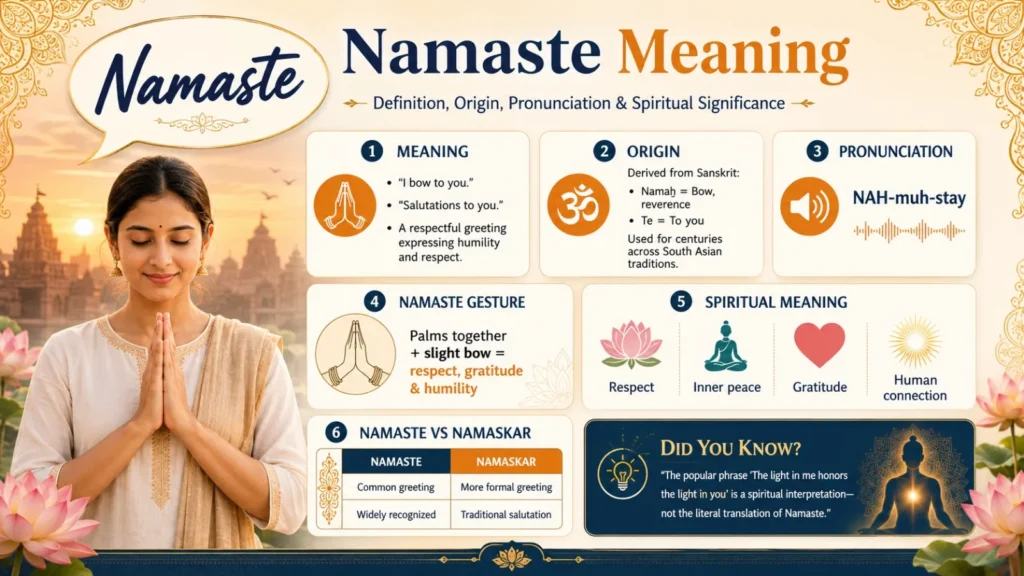
| Aspect | Simple Answer |
| Literal meaning | “I bow to you” or “salutations to you.” |
| Language origin | Sanskrit. |
| Pronunciation | NAH-muh-stay in English usage. |
| Gesture | Palms pressed together with a slight bow; often linked to Anjali Mudra. |
| Common use | Respectful greeting, farewell, gratitude, and yoga closing. |
What Does Namaste Mean?
The clearest English meaning of Namaste is “I bow to you.” Merriam-Webster and Dictionary.com both trace the word to Sanskrit roots meaning bowing, homage, or reverence, which is why it is often translated as a respectful salutation rather than a casual hello.
That literal meaning matters, but the social meaning matters too. In real use, Namaste is a way of recognizing another person with humility, courtesy, and respect. In other words, it is not just about words; it is about attitude.
Origin and History
Namaste comes from Sanskrit, the classical language behind many Hindu and South Asian philosophical and religious terms. Dictionary.com explains that it is built from the root namas and the ending te, while Merriam-Webster notes that the word entered English as a greeting associated with Sanskrit usage.
A useful Historical Point for readers is that the word is old, but its wide global visibility is modern. Today, many people encounter it through yoga classes, wellness content, and internet usage, which is why searchers often want both the traditional meaning and the modern context.
How to Pronounce Namaste
The common English pronunciation is NAH-muh-stay. Merriam-Webster and Yoga Journal both present this pronunciation clearly, and Yoga Journal specifically notes that pronunciation is important because many people first learn the word through yoga or online content rather than direct cultural exposure.
A small pronunciation section is worth including in any meaning article because it helps both beginners and voice-search users. It also improves the page’s chance of matching a “how do you say it?” search intent.
The Namaste Gesture: What Is Anjali Mudra?
The hand gesture often connected with Namaste is called Anjali Mudra. Yoga Journal describes it as the hands coming together near the heart center, and other references explain that the gesture is commonly paired with a slight bow. Dictionary.com also describes Namaste as a greeting used with palms pressed together at the chest or head.
This gesture is more than a visual habit. It communicates respect, sincerity, and presence. In yoga and related traditions, it often symbolizes a quiet acknowledgment of the other person with humility and warmth.
Namaste in Yoga
Namaste is strongly associated with yoga in modern English. Yoga Journal’s coverage shows that people often ask what it means, how to pronounce it, and when to use it in yoga settings, which reflects how closely the word has become tied to the practice.
At the same time, yoga writers also caution against using it carelessly as a slogan or decorative trend. Yoga Journal explicitly discusses the inappropriate or commercialized use of Namaste, which is useful context for readers who want to use the word respectfully.
Namaste vs Namaskar
Namaste and Namaskar are related, but not the same in common explanation. Dictionary.com notes that both share the Sanskrit root namas, while Namaskar is built from namas and kara (“doing”), and it is often presented as the more formal salutation. Namaste is usually translated as a respectful greeting like “I bow to you.”
| Word | Common Meaning | Typical Tone |
| Namaste | “I bow to you,” “salutations to you” | Respectful, familiar, widely recognized |
| Namaskar | Formal salutation based on the same root | More formal, traditional, reverential |
For SEO, this comparison is valuable because many readers search for the two words together when trying to understand whether they can be used interchangeably. The safest answer is that they are closely related, but Namaskar is usually treated as more formal.

Is Namaste Religious or Spiritual?
Namaste can carry spiritual meaning, but it is not only a spiritual phrase. Arhanta Yoga explains that the word comes from Sanskrit and means “I bow to you,” while also cautioning that it is not simply mystical or religious in every use. Yoga Journal similarly frames it as a term tied to yoga philosophy and respectful practice, while also warning against oversimplification.
A balanced explanation is best here: in spiritual contexts, Namaste may express the idea of recognizing the sacred, divine, or essential dignity in another person. In everyday use, it can simply be a respectful greeting. Both readings can exist depending on context.
When Do People Say Namaste?
People may say Namaste when greeting someone, when saying goodbye, or when offering thanks or respect. Dictionary.com and Merriam-Webster both support its use as a respectful salutation, and Yoga Journal shows that modern yoga use often places it at the end of a class as a closing gesture of gratitude.
That wider use is one reason the word appears so often in search results. Readers are not only asking for a translation; they are also asking when the word is appropriate, what it implies, and how to avoid using it carelessly.
Common Misunderstandings About Namaste
One common misconception is that Namaste only means “hello.” In reality, it can also function as a respectful goodbye or a sign of gratitude. Another common misunderstanding is that it literally means “the light in me sees the light in you.” That phrase is a Popular Spiritual interpretation, but it is not the direct dictionary translation.
A third mistake is treating the word like a joke, a trend, or a decorative slogan. Yoga Journal specifically discusses the problem of commercialized or inappropriate use, which is why respectful context matters.
How to Use Namaste Respectfully
Use Namaste when you genuinely want to show respect, humility, or gratitude. It works best in contexts where thoughtful greeting makes sense, especially in relation to Indian culture, yoga, or spiritual practice.
Outside those contexts, the safest approach is to keep the tone sincere and avoid using it as a meme, costume detail, or marketing gimmick. That guidance matches the caution raised by cultural and yoga-focused sources about respectful use.
People Also Ask
A: It usually means “I bow to you” or “salutations to you.” That is the simplest and most widely accepted English explanation.
A: Its roots are in Sanskrit, and it is widely used in South Asian cultural and spiritual contexts. Many English-language sources describe it as a Sanskrit greeting rather than a Hindi-only word.
A: In spiritual reading, it can mean recognizing the sacred, divine, or essential dignity in another person. Some explanations present this as a core philosophy behind the greeting, especially in yoga and Hindu contexts.
A: Both are respectful salutations, but Namaskar is generally treated as the more formal expression. Namaste is the more commonly recognized form in English.
A: Yoga teachers often use it as a respectful closing that expresses gratitude and acknowledgment after practice. Yoga Journal shows that this is one of the most common modern settings where people hear the word.
Conclusion
Namaste is far more than a simple greeting—it is a timeless expression of respect, humility, and human connection rooted in the ancient Sanskrit language. While its literal translation is “I bow to you” or “salutations to you,” its deeper significance lies in acknowledging the dignity and worth of another person. Whether spoken in everyday conversations across India, used at the end of a yoga class, or accompanied by the traditional Anjali Mudra gesture, Namaste reflects kindness, gratitude, and mutual respect.
Understanding the true Namaste meaning also helps clear up common misconceptions. It is not just a fashionable yoga phrase or a direct translation of “the light in me honors the light in you.” Instead, it is a culturally significant greeting with centuries of history and meaningful traditions behind it. Using the word respectfully—while appreciating its origins and context—shows cultural awareness and genuine courtesy.
If you were searching for the meaning, pronunciation, origin, spiritual significance, or correct usage of Namaste, you now have a complete understanding of this Beautiful Expression. For more language, culture, and spiritual meaning guides, explore our related articles and continue expanding your knowledge of words that connect people across cultures.