
Solfege Meaning
If you have ever heard someone say “Do-Re-Mi” in a music class, choir rehearsal, or movie song, they were probably talking about solfege. In simple terms, Solfege Meaning is a music-learning system that uses syllables instead of letter names to help people hear pitch, sing melodies more accurately, and understand how notes relate to one another. Solfège is commonly pronounced /sɒlˈfeʒ/ in UK English and /ˈsoʊl.fedʒ/ in US English, according to Cambridge.
Musicians use solfege because it turns abstract notes into something easier to hear and remember. That is why it appears in ear training, sight-singing, choir practice, and beginner theory lessons. The best part is that solfege is not just for children or beginners. It is a practical tool for singers, pianists, and music students who want to build stronger pitch awareness and a better musical ear. Solfège is widely described as a syllable-based system for naming notes and practicing scales.
What Does Solfege Mean?
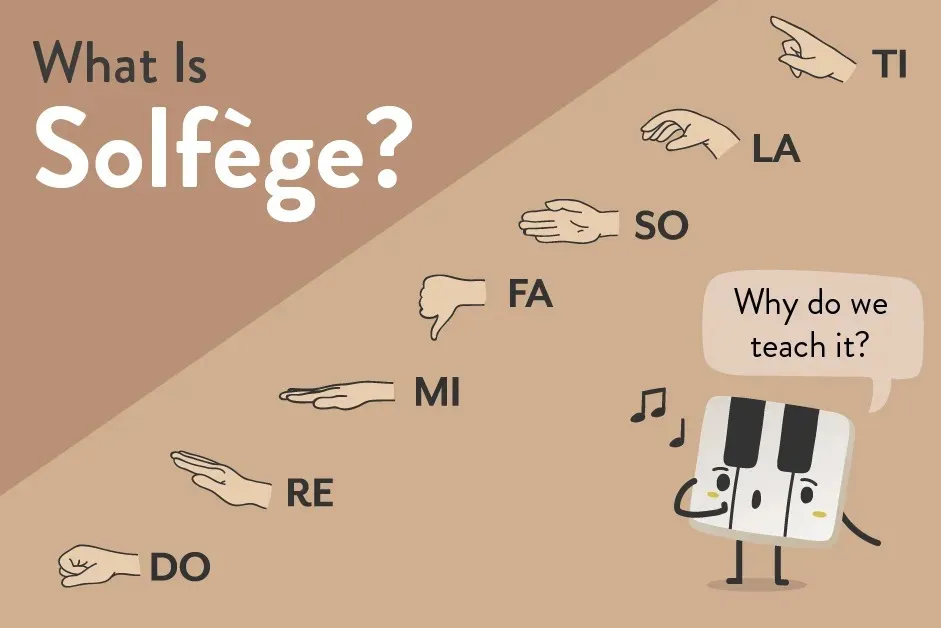
Solfege is a musical system that assigns syllables such as Do, Re, Mi, Fa, Sol, La, Ti to the notes of a scale. In dictionary definitions, it is described as the application of sol-fa syllables to a scale or melody, or as a singing exercise that uses those syllables.
Quick Meaning Summary
| Term | Simple Meaning |
| Solfege | A note-syllable system used in music learning |
| Solfège | The French spelling of the same idea |
| Solfeggio | An older related term |
| Solmization | The broader category of naming pitches with syllables |
Solfège and solfeggio are related forms of the same music concept, while solmization is the broader term for systems that name pitches with syllables.
The Do-Re-Mi Syllables
The most familiar solfege sequence is:
Do – Re – Mi – Fa – Sol – La – Ti – Do
This set is used to represent the notes of a scale and to help singers hear musical relationships more clearly. In beginner music education, the syllables are often taught with a major scale because they make scale motion easier to remember and sing.
A simple example is C major:
C – D – E – F – G – A – B – C
becomes
Do – Re – Mi – Fa – Sol – La – Ti – Do
Where Solfege Came From
The history of solfege is usually traced to Guido of Arezzo, an 11th-century Italian music theorist who helped develop a syllable-based way to teach notes and sight-singing. Educational sources note that his system used syllables such as ut, re, mi, fa, sol, la, and these syllables became the foundation of later solmization practice.
A major reason the system mattered is that it gave singers a practical way to remember pitches and read music more accurately. That Historical Teaching Method became one of the roots of modern solfege, especially in music education and aural training.

Fixed Do vs Movable Do
There are two main solfege systems in use today: fixed do and movable do. The core difference is whether the syllables stay tied to the same pitch or move with the key.
| System | How It Works | Best For |
| Fixed do | Each syllable always matches the same pitch | Pitch naming, absolute note memory |
| Movable do | Do becomes the tonic of whatever key you are in | Relative pitch, scale function, transposition |
In fixed do, Do always represents one pitch. In movable do, Do always represents the tonic, so the syllables shift whenever the key changes. That makes movable do especially useful for understanding scale degrees and harmonic function.
Why Musicians Use Solfege
Musicians use solfege because it helps them think in sound instead of only symbols. It supports ear training, sight-singing, and pitch recognition, and it gives learners a clearer sense of how notes move inside a scale. Music educators also use it because syllables are often easier to sing than letter names.
Solfege can help students:
- sing melodies more accurately
- recognize intervals faster
- read music with more confidence
- understand scale relationships
- transpose music into new keys
- strengthen relative pitch and aural memory
Solfege Examples for Beginners
Example 1: Major Scale
In C major, the scale becomes:
Do – Re – Mi – Fa – Sol – La – Ti – Do
Example 2: Simple Melody
A melody that moves from Do to Mi helps train the ear to hear a major third.
Example 3: Singing Practice
A student may sing Do – Mi – Sol to hear a basic major triad shape.
These short patterns are popular because they make pitch relationships easier to hear and repeat.
Solfege in Singing, Piano, and Sight-Reading
Solfege is common in choir training, vocal lessons, and beginner theory classes, but it also helps instrumentalists. Singers use it to stay on pitch, pianists use it to understand melody movement, and music students use it to connect what they see on the page with what they hear in sound. Solfege is especially useful for sight-reading because it builds a direct link between notation and hearing.
Solfege vs Solfeggio vs Solmization
These terms are related, but they are not identical.
Solfege is the modern classroom term most people know.
Solfeggio is the older related form.
Solmization is the broader music-theory category for naming pitches with syllables.
Common Misunderstandings
A common mistake is assuming that Do always means C. That is true in fixed do, but not in movable do, where Do changes with the key. Another mistake is treating solfege as only a beginner exercise. In reality, it is a serious ear-training tool used throughout music education.
Is Solfege the Same as Do-Re-Mi?
In everyday speech, many people use solfege and Do-Re-Mi as if they mean the same thing. Technically, solfege is the system, and Do-Re-Mi are the syllables used inside that system. So “Do-Re-Mi” is the most famous example of solfege, but the word solfege covers the full learning method.

People Also Ask
A: Solfege is a music system that uses syllables like Do, Re, Mi, Fa, Sol, La, and Ti to name notes and train the ear. It helps singers and students understand pitch and melody more easily.
A: Cambridge gives the English pronunciation as UK /sɒlˈfeʒ/ and US /ˈsoʊl.fedʒ/. Many speakers also say it in a simplified way during music lessons.
A: Fixed do keeps each syllable tied to one pitch. Movable do changes the syllables with the key, so Do is always the tonic.
A: Musicians use it to build stronger ear training, improve sight-singing, and understand how notes function inside a scale.
A: The system is usually linked to Guido of Arezzo, whose 11th-century teaching methods helped shape modern solmization and singing instruction.
Conclusion
Understanding solfege meaning is the first step toward developing stronger musical skills. More than just the familiar Do, Re, Mi syllables, solfege is a proven teaching system that helps singers, instrumentalists, and music students recognize pitch, understand note relationships, and improve sight-singing with confidence.
Whether you learn fixed do or movable do, practicing solfege regularly strengthens your ear, makes reading music easier, and builds a deeper understanding of melody and harmony. Its centuries-long use in music education shows just how effective it is for beginners and experienced musicians alike.
If you’re starting your musical journey, learning solfege is one of the best investments you can make. By mastering these simple syllables, you’ll build a solid foundation for singing, Playing Instruments, composing music, and understanding music theory for years to come.