Surreal Meaning: What Does Surreal Mean?
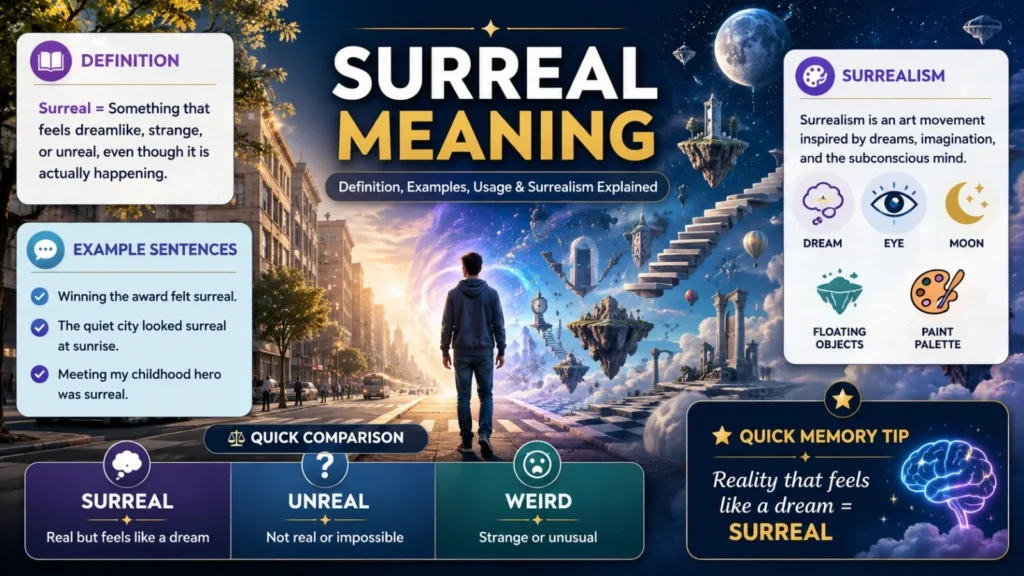
The phrase Surreal Meaning is searched by people who want a clear, simple explanation of the word surreal. In everyday English, surreal describes something that feels strange, dreamlike, or not fully real, even though it is actually happening. It is often used when a moment feels too unusual, too intense, or too unbelievable to process normally.
You might hear someone say, “That experience felt surreal,” after a major life event, a shocking surprise, a beautiful scene, or even a stressful moment. The word is useful because it captures a feeling that is hard to describe with ordinary words. It does not always mean fake or imaginary. Instead, it often means real life feels so unusual that it seems like a dream.
This article explains the surreal definition, how to use it correctly, the difference between surreal, unreal, and weird, plus practical examples and the connection to Surrealism. If you want the meaning in simple English, this guide gives you the full answer in one place.
What Does Surreal Mean?
Surreal means something feels dreamlike, strange, unusual, or almost unreal. It often describes a real experience that seems too unusual to fully believe or understand right away.
Quick meaning summary
| Word | Simple meaning | Common use |
| Surreal | Real, but feels dreamlike or strange | Life events, emotions, experiences |
| Unreal | Not real, impossible, or extremely amazing | Casual speech, exaggeration, disbelief |
| Weird | Odd, unusual, awkward, or unexpected | Everyday conversation |
A simple way to remember it is this:
Surreal = real, but feels unreal.
Surreal Meaning in Simple English
In simple English, surreal means:
Something is happening in real life, but it feels so strange, dreamlike, or unbelievable that it does not feel completely real.
This is why people often use it after an Emotional or Shocking Moment. The experience is real, but the brain struggles to process it.
Examples of situations that may feel surreal:
- winning a big award
- meeting someone famous
- seeing a life-changing event happen
- looking at a scene that feels too beautiful or unusual
- hearing shocking news
Surreal Meaning in English
In everyday English, surreal is an adjective used to describe a feeling, scene, moment, or experience that seems detached from normal reality. It can describe beauty, shock, confusion, awe, or emotional overload.
It does not always mean “fake.” A surreal moment can be completely real. It only means the experience feels unusual, dreamlike, or hard to process.
Example:
- “The empty city at midnight felt surreal.”
This sentence does not mean the city was imaginary. It means the scene felt strange and dreamlike.
Surreal Examples in Sentences
Here are natural surreal sentence examples:
- Winning the competition felt surreal.
- The whole day felt surreal after I got the news.
- Standing on that stage in front of thousands of people felt surreal.
- The silence in the city made the night feel surreal.
- Seeing my childhood home after so many years felt completely surreal.
- The sunset over the ocean looked almost surreal.
- After the accident, everything around him felt surreal.
- It was a surreal experience to meet my favorite actor.
These examples show that surreal is often used for experiences that are emotionally powerful or visually unusual.
Surreal Meaning in Real-Life Use
People use surreal in real-life conversation when they want to express that something feels hard to believe in the moment.
Common uses:
- after a major success
- during shocking news
- in emotional life events
- when describing a beautiful or unusual scene
- when something feels like a dream
Example in daily conversation:
- “It was surreal hearing my name called on stage.”
This sounds natural because the speaker is describing a real event that felt emotionally overwhelming.
Surreal vs Unreal vs Weird
These words are related, but they are not the same.
Surreal
Real, but feels dreamlike, strange, or unreal.
Unreal
Can mean not real, impossible, or amazingly good depending on context.
Weird
Means odd, unusual, awkward, or unexpected.
| Word | Main idea | Tone |
| Surreal | Real life feels dreamlike | Emotional, vivid |
| Unreal | Not real or hard to believe | Broad, flexible |
| Weird | Strange or odd | Casual, everyday |
Simple memory trick:
- Weird = unusual
- Unreal = not real or unbelievable
- Surreal = real, but feels unreal
Surreal in Art and Surrealism
The word surreal is closely linked to Surrealism, which was an art and literary movement focused on dreams, imagination, the subconscious mind, and scenes that do not follow normal logic.
Surrealism often includes:
- dream imagery
- strange combinations of objects
- unusual scenes
- symbolic meaning
- subconscious thoughts
In art, Surrealism tries to show what the mind feels like beneath Ordinary Reality. Famous artists such as Salvador Dalí are often connected with this style.
Easy way to understand it:
- Surrealism = the art movement
- surreal = the everyday word used to describe dreamlike or strange real-life moments
Why Does Something Feel Surreal?
Something feels surreal when the brain has trouble processing it quickly. This usually happens when the moment is:
- emotionally intense
- unexpected
- beautiful
- shocking
- too unusual to feel normal
When reality changes too fast, your mind may describe it as surreal because it feels like you are still inside a dream.
Examples:
- getting life-changing news
- meeting someone you admire
- returning to a place from childhood
- surviving a frightening event
- reaching a dream goal
Surreal Synonyms and Related Words
Here are useful surreal synonyms and closely related words:
- dreamlike
- strange
- unusual
- bizarre
- unreal
- fantastic
- unbelievable
- otherworldly
- uncanny
- mind-bending
Related expressions:
- like a dream
- too strange to believe
- hard to process
- emotionally overwhelming
- detached from reality
These words are helpful when you want to vary your writing without repeating surreal too often.
Common Mistakes People Make
Many people use surreal correctly, but there are a few common mistakes.
1. Using it for every strange thing
Not everything unusual is surreal. Sometimes “weird” or “odd” is the better choice.
2. Confusing surreal with unreal
They overlap, but they are not identical. Surreal usually means real life feels dreamlike.
3. Thinking it only applies to art
Surreal is used in daily conversation too, not just in art or literature.
4. Assuming it is always positive
Surreal can describe beauty, shock, fear, sadness, or awe.
Common Questions About Surreal Meaning
Is surreal a positive word?
Not always. It can be positive, negative, or neutral depending on the situation.
Can surreal describe real life?
Yes. It is often used for real situations that feel dreamlike or hard to believe.
Is surreal the same as weird?
No. Weird means odd or unusual. Surreal means real life Feels Strange or Dreamlike.
Is surreal a synonym of unreal?
Sometimes, but not always. Unreal is broader, while surreal has a more dreamlike feeling.
What is the opposite of surreal?
Possible opposites include ordinary, normal, realistic, or familiar.
People Also Ask
A: Surreal means something feels strange, dreamlike, or not fully real, even though it is actually happening.
A: You can say, “Winning the award felt surreal,” or “The empty street looked surreal at night.”
A: Surreal means real but dreamlike. Unreal can mean fake, impossible, or extremely amazing.
A: Yes. It is a common English adjective used in everyday speech, writing, art, and description.
A: Surrealism is an art and literary movement connected to dreams, imagination, and the subconscious mind.
Conclusion
Understanding the surreal meaning helps you describe moments that feel dreamlike, strange, or almost impossible to believe. Unlike unreal, which often means something is fake or impossible, surreal usually refers to real experiences that feel extraordinary or emotionally overwhelming. Whether you’re talking about a life-changing event, a breathtaking landscape, or a piece of Surrealist Art, this word perfectly captures the feeling of reality becoming unexpectedly dreamlike.
As you’ve learned, surreal is commonly used in everyday conversations, literature, movies, and art to express experiences that are difficult to process because they seem so unusual. Knowing the difference between surreal, weird, and unreal, along with their proper usage and examples, will help you use the word more confidently in both speaking and writing.
If you found this guide helpful, explore more English meaning guides on Capzoon to expand your vocabulary, improve your communication skills, and understand the true meanings of commonly searched words and expressions.