Poignant Meaning
Poignant is a word people search for when they want a clear, simple meaning that goes beyond a dictionary line. In modern English, it usually describes something emotionally powerful and touching, often a little sad or bittersweet. That is why you see it used for memories, speeches, films, photographs, and moments that stay with you. Merriam-Webster, Cambridge, Collins, Dictionary.com, and Vocabulary.com all place the word in the emotional range of “deeply affecting,” “touching,” or “painful to the feelings,” while also preserving older senses connected to sharpness or pungency.
This guide explains the Poignant Meaning in simple English, shows how to pronounce it, provides real-sentence examples, compares it with piquant and moving, and explains the word’s origin. By the end, you will know exactly how to use poignant naturally and correctly. Its historical roots trace back through Old French and Latin to the idea of “pricking” or “stinging,” which is why the emotional meaning feels so vivid today.
Quick Meaning Summary
| Term | Simple Meaning |
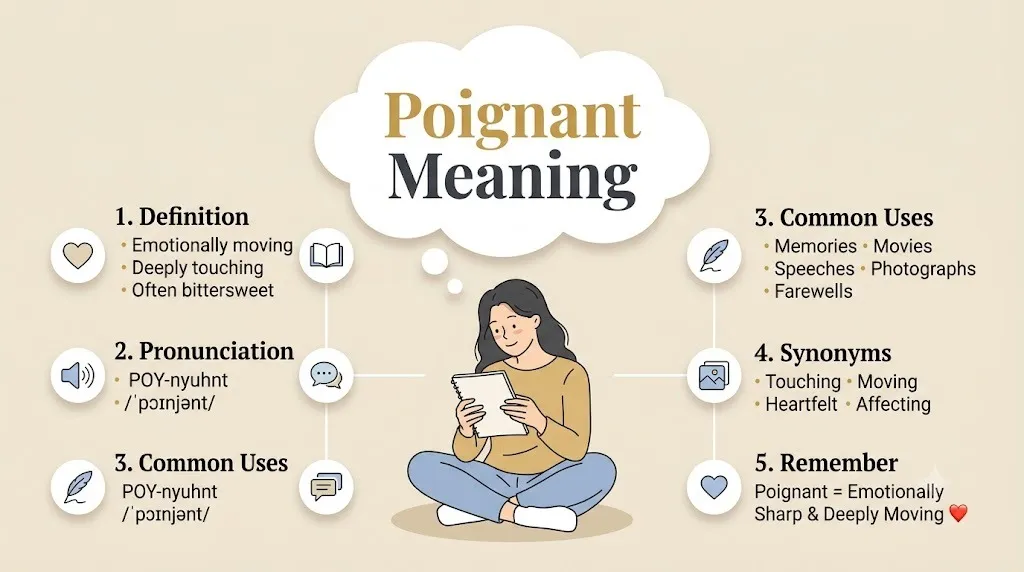
| Poignant | Deeply affecting, touching, or emotionally powerful, often in a sad, tender, or bittersweet way |
| Poignancy | The quality of being poignant |
| Poignantly | In a poignant way |
| Pronunciation | POY-nyuhnt / POY-nənt |
| Common use | Memories, scenes, speeches, stories, photos, and farewells |
The major dictionary sources agree that poignant is an adjective used for emotions, while some also preserve older senses related to sharpness, mental appeal, or pungency. Collins also lists poignancy and poignantly as the related noun and adverb forms.
What Does Poignant Mean?
Poignant means something that strongly affects your feelings. Most often, it suggests a feeling that is sad, tender, moving, or bittersweet. Merriam-Webster describes it as something that sharply or piercingly stirs emotions, while Cambridge defines it as causing a very sharp feeling of sadness. Collins and Dictionary.com also place the word in the range of painful, touching, or emotionally affecting language.
In simple English, poignant means:
emotionally powerful in a way that touches the heart.
It is not just “sad.” A moment can be poignant because it feels tender, nostalgic, reflective, or beautifully painful. The OED also notes a later sense that can be sorrowful yet somehow tender or bittersweet.

Poignant Pronunciation
The common pronunciations are:
- UK: /ˈpɔɪnjənt/ or /ˈpɔɪnənt/
- US: /ˈpɔɪnjənt/ or /ˈpɔɪnənt/
A simple spoken version is: POY-nyuhnt or POY-nənt. Collins lists both British and American pronunciations in this form.
Poignant in Simple English
If you only remember one line, Remember this:
Poignant means deeply touching and emotionally strong, usually in a sad or bittersweet way.
That is why people use it for:
- a childhood photo that brings back memories
- a farewell speech that makes people cry
- a movie ending that stays in your heart
- a story that feels tender and painful at the same time
Vocabulary.com explains the word as something that “pricks” your emotions, especially in a melancholy way. That idea matches the emotional definitions given by the major dictionaries.
Examples of Poignant in Sentences
Here are original examples you can use in writing:
- The old photograph was a poignant reminder of her childhood.
- His farewell speech was so poignant that several people cried.
- The movie ended with a poignant scene that stayed in my mind for days.
- Her message was short, but it felt deeply poignant.
- The song became poignant after we learned the story behind it.
- The final chapter gave the novel a poignant and unforgettable close.
These examples reflect the word’s modern emotional sense as used by the leading dictionary sources.
Poignant Synonyms and Related Words
Useful synonyms include:
- moving
- touching
- affecting
- emotional
- heartfelt
- tender
- bittersweet
- distressing
- impactful
Merriam-Webster groups poignant with words such as affecting, moving, touching, impressive, and pathetic in the sense of producing deep emotion. Dictionary.com also lists similar emotionally strong synonyms.
Related words:
- poignancy — the quality of being poignant
- poignantly — in a poignant way
- pungent — sharp in smell or taste
- piquant — pleasantly sharp, lively, or mildly stimulating
Poignant vs. Piquant
This is one of the most important comparison points for searchers.
Poignant is about emotion.
Piquant is about sharpness, liveliness, or a slightly spicy/tangy quality.
Merriam-Webster’s synonym notes connect these words historically, but they are not interchangeable. It explains that poignant refers to something that sharply affects emotions, while piquant suggests something that whets interest or appetite. Collins and Vocabulary.com also show the same family link through the older “prick/sting” origin.
| Word | Main Idea | Example |
| Poignant | Emotionally moving or sad | a poignant farewell |
| Piquant | Sharp, lively, or tangy | a piquant sauce |
| Pungent | Strong smell or biting sharpness | a pungent odor |
A simple memory trick:
Poignant = heart
Piquant = taste/interest
Pungent = smell/sharpness
Poignant vs. Moving
These words overlap, but they are not identical.
Moving is broad. It can describe anything that causes strong emotion, whether sad, inspiring, warm, or uplifting. Poignant is more specific. It usually carries a sharper feeling, often linked to sorrow, memory, tenderness, or loss. Merriam-Webster’s synonym notes place poignant among words that produce deep emotion, but its emotional edge is more piercing than the general word moving.
In short:
- moving = emotionally strong
- poignant = emotionally strong with a sharper, more bittersweet feeling
Poignant Etymology and Word Origin
The word poignant comes from French and Latin. Etymology sources trace it back to Old French and Latin pungere, meaning “to prick,” “pierce,” or “sting.” Vocabulary.com, Etymonline, Collins, and Wiktionary all point to the same root family. That root also explains the connection to pungent.
That history makes the meaning easier to remember:
Poignant = something that “pricks” your emotions.
The OED adds that later uses became more clearly emotional, often sorrowful but tender or bittersweet.

Poignancy Meaning
Poignancy is the noun form of poignant. It means the quality of being Emotionally Touching, sad, or deeply moving. Collins and Dictionary.com both recognize this noun form.
Example:
- The poignancy of the scene made the ending unforgettable.
Common Mistakes with Poignant
1) Using it for ordinary emotion
Not every emotional moment is poignant. The word usually suggests a deeper feeling, often involving memory, sadness, tenderness, or reflection.
2) Confusing it with piquant
Poignant is emotional. Piquant is sharp, lively, or tangy.
3) Forgetting the older senses
Some dictionaries still preserve older meanings tied to sharpness, smell, or mental appeal. Those senses are real, but the emotional meaning is the one most readers look for today.
4) Overusing it where “touching” is enough
If the feeling is gentle and simple, touching may be better. Use poignant when you want a more mature, slightly sharper emotional tone.
People Also Ask
A: Poignant means deeply touching, emotionally powerful, and often sad or bittersweet. Dictionaries consistently place it in this emotional range.
A: Usually, yes. It often carries sadness, memory, loss, or tenderness, though it can also describe something beautifully moving.
A: Common synonyms include moving, touching, affecting, heartfelt, and emotional.
A: Touching is softer and broader. Poignant is usually deeper, sharper, and more emotionally intense. This is an inference from the way the major dictionaries distinguish the word’s emotional force.
A: Yes, in older or less common senses it can relate to sharpness, pungency, or mental bite. Collins and Merriam-Webster preserve those older senses alongside the modern emotional meaning.
Conclusion
Understanding the poignant meaning helps you describe emotions with greater accuracy and depth. Today, poignant is most commonly used for moments, memories, stories, speeches, photographs, and experiences that Deeply Touch the heart, often with a sense of sadness, tenderness, or bittersweet reflection. While the word originally came from a root meaning “to prick” or “to sting,” its modern use focuses on emotions that leave a lasting impression rather than physical sharpness. By remembering that poignant = emotionally moving and deeply affecting, you’ll be able to use this word naturally in both everyday conversations and formal writing. Whether you’re reading literature, watching a film, or describing a meaningful life experience, poignant is the perfect word for emotions that stay with you long after the moment has passed.